

By Peterson Micheni | Counselling Psychologist | Pragma Counsellors
How to Set Boundaries With Family!?
She had not taken a holiday in four years.Not because she could not afford one. Not because she did not want one. Because every time she tried to plan one, something came up with her family. A crisis. A request. A guilt trip so expertly delivered that by the end of the phone call she had not only cancelled her plans she had apologised for making them in the first place.
She was the eldest of five children. The one everyone called first. The one who was expected to be available at all times, to solve every problem, to show up for every occasion regardless of her own life. She had been doing this since she was twelve years old and her mother started treating her as a second parent.
When she finally sat across from me and I used the word “boundaries,” she looked genuinely frightened.
“In my family,” she said quietly, “boundaries are just a fancy word for being selfish.”
That sentence is the reason I am writing this article.
Because I have heard some version of it from more clients than I can count across cultures, across income levels, across every type of family structure. The belief that having limits within your own family is a betrayal of love, a failure of loyalty, a declaration of selfishness. And because that belief, held long enough and hard enough, costs people their health, their identity, their relationships, and sometimes their sanity.
Boundaries are not walls. They are not cruelty. They are not a rejection of the people you love. This article is going to tell you exactly what they are, why family is the hardest place to have them, and specifically how to set them without destroying the relationships that matter to you.
Table of Contents
- What Boundaries Actually Are — And What They Are Not
- Why Family Is the Hardest Place to Have Boundaries
- 8 Signs You Desperately Need Better Boundaries With Family
- 7 Types of Family Boundaries and How to Set Each One
- The Real Talk: What Happens When You Start Setting Boundaries
- How to Set a Boundary Without Destroying the Relationship
- Books That Have Transformed How My Clients Think About This
- FAQ
What Boundaries Actually Are — And What They Are Not {#what-is}
I want to spend a moment here because I think the word “boundaries” has been used so loosely in popular culture that it has started to mean almost nothing or worse, it has become associated with coldness, selfishness, and the kind of aggressively individualistic self-help philosophy that treats every relationship as a transaction.
That is not what I mean by boundaries. And it is not what the clinical and research literature means either.
A boundary is simply a definition of what you will and will not participate in. It is a communication to yourself first, and then to others about where you end and another person begins. It is the answer to the question: what can I genuinely offer in this relationship, consistently, without depleting myself to the point of resentment?
Boundaries are not about controlling other people. You cannot set a boundary that dictates what someone else does, you can only define what you will do in response to their behaviour. “You cannot speak to me that way” is not a boundary. “If you speak to me that way, I will end the conversation” that is a boundary.
Boundaries are not punishment. They are not revenge. They are not declarations of superiority. They are, at their most fundamental level, an act of honesty. You are telling someone the truth about what you can and cannot give. That truth protects both of you because a relationship built on one person giving what they do not have, and cannot sustain, is a relationship built on resentment.
The reason boundaries feel so radical in family contexts is that families frequently operate on an unspoken agreement that your needs are permanently subordinate to the family’s needs. Naming your limits disrupts that agreement. And disrupting family agreements even harmful, unsustainable ones is uncomfortable for everyone involved.
If you recognise people-pleasing patterns in yourself, boundary-setting with family will be particularly challenging, because the two patterns are deeply interconnected. The people-pleasing habit was almost certainly learned in a family context. Setting limits within that same context is asking the original source of the wound to accept a new way of relating. That is genuinely hard work.

Why Family Is the Hardest Place to Have Boundaries {#why-hard}
You can set a boundary with a colleague and move on. You can limit your contact with a difficult friend. But family is different and pretending otherwise is one of the ways well-meaning advice about boundaries fails people.
The history is longer and deeper. Every family interaction carries decades of accumulated meaning, established roles, and implicit expectations. You are not just speaking to your mother in this moment, you are speaking to every version of that relationship you have ever had. The emotional stakes are categorically different from any other relationship.
The roles were set before you could consent to them. Most destructive family dynamics were established when the people in them were children before they had the cognitive development, the language, or the power to negotiate them. You did not choose to be the family peacemaker, the responsible one, the emotional support system, the one who is always available. You were assigned that role, often before you were old enough to understand what was happening.
Guilt is weaponised in family systems. Not always consciously. Not always cruelly. But family guilt is extraordinarily effective, because it is attached to the people who first shaped your sense of who you are. Disapproval from a parent activates something in the nervous system that no amount of adult logic can fully override. Research in attachment theory shows that the fear of abandonment by early caregivers leaves neurological traces that persist into adulthood which is why your forty-two-year-old self can still feel like a frightened child when your mother’s voice takes a particular tone.
The cultural dimension. In many cultures, South Asian, African, Latin American, Middle Eastern, East Asian, the very concept of individual limits within family is framed as incompatible with the cultural values of collectivism, filial piety, and communal obligation. I understand and respect those values. And I have also watched them be used to keep people in genuinely harmful, depleting, and sometimes abusive family dynamics with no permission to name what is happening. Cultural values and personal limits are not mutually exclusive. But navigating that intersection requires care and often requires support.
If your family boundary struggles are connected to childhood trauma, which they frequently are, the difficulty you experience is not weakness. It is a neurologically grounded response to a system that was specifically designed to keep you in a particular role.

8 Signs You Desperately Need Better Boundaries With Family {#signs}
1. You Feel Drained After Almost Every Family Interaction
Not occasionally consistently. Visits, phone calls, family gatherings leave you exhausted in a way that has nothing to do with the length of the interaction and everything to do with the emotional labour it requires.
Healthy relationships are energising as often as they are depleting. When a relationship is consistently draining when you need recovery time after every contact that pattern is telling you something about the dynamic that deserves attention.
2. You Cannot Say No Without a Major Production
Saying no to a family member triggers guilt, anxiety, extended justification, and often a reversal of your decision before the conversation is over. You have learned that saying no costs so much more than saying yes, so you default to yes to avoid the cost.
This is not a free choice. It is a conditioned response to a system where your no has never been accepted as sufficient.
3. Your Family Makes Decisions About Your Life Without Asking
Your time, your money, your home, your relationships, family members feel entitled to have opinions about and influence over these things, and they express those opinions and exercise that influence whether you have invited them to or not.
You find yourself defending your own choices to people who did not ask and whose approval you did not seek. This is a boundary problem, not in you, but in the relationship system.
4. You Are the Emotional Caretaker for the Whole Family
Everyone calls you with their problems. You manage everyone’s feelings. You mediate every conflict. You are the one who holds the family together and you do it at significant personal cost that nobody acknowledges because it has simply become what you do.
This role sometimes called the family emotional caretaker or the parentified child in clinical literature, is one of the most exhausting and least visible forms of boundary violation. You did not apply for the job. You were assigned it. And resigning from it will require the clearest and most consistent boundary work you have ever done.

5. Your Boundaries Have Been Broken So Many Times You Have Stopped Setting Them
You tried saying no once and the response was so overwhelming, guilt, anger, silence, manipulation that you have not tried again. You have concluded that boundaries simply do not work with your family. You have surrendered the attempt.
This is not evidence that you cannot have limits. It is evidence that your family system has an established mechanism for enforcing compliance. That mechanism can be navigated but it requires understanding, preparation, and often professional support.
6. You Live in Fear of Family Disapproval
Major life decisions, career choices, relationship choices, where to live, how to spend your money, whether to have children, are made with one eye constantly on what your family will think. Their potential disapproval has genuine power over your choices.
A certain degree of caring what your family thinks is healthy. When that care becomes a governing force that overrides your own judgment about your own life, it has crossed into something that deserves examination.
7. You Feel Responsible for Your Family’s Emotional State
When a family member is unhappy, you feel responsible for fixing it, even when their unhappiness has nothing to do with you. When there is conflict in the family, you feel compelled to resolve it, even when it is not yours to resolve. Your own emotional state is consistently secondary to the management of everyone else’s.
8. Resentment Has Quietly Replaced Love
You love your family. And you have started to resent them. The two feelings coexist in a way that produces enormous guilt, because you believe you should not feel resentment toward people you love.
But resentment is not a character flaw. It is a reliable signal that something has been given that was not freely offered, given out of obligation, fear, or guilt rather than genuine choice. The resentment is telling you that a limit has been crossed, repeatedly, and that the crossing has gone unaddressed for too long.
7 Types of Family Boundaries and How to Set Each One {#types}
1. Emotional Boundaries, Protecting Your Inner World
What it looks like being broken: family members expect you to manage their emotions, share your private feelings on demand, or take responsibility for how they feel about your choices.
How to set it: “I love you and I am not able to be your primary emotional support. I think it would help us both if you spoke to someone about this.” Or simply: “I am not in a position to discuss that right now.”
2. Time Boundaries, Your Schedule Is Yours
What it looks like being broken: last-minute demands on your time, expectations that you will be available whenever the family needs you regardless of your own commitments, guilt when you are unavailable.
How to set it: “I can visit on Saturday afternoon. I am not available this weekend.” Say it once. Do not over-explain. Do not apologise for having a life.
3. Financial Boundaries, Your Money Is Not a Family Resource
What it looks like being broken: regular requests for money, expectations that you will contribute to family expenses beyond what you have agreed to, guilt for spending your own income on your own life.
How to set it: “I am not able to lend money, I have found it affects our relationship and I want to protect that. I hope you find another solution.” This is one complete sentence. It does not require a financial report on your circumstances.
4. Physical Boundaries, Your Space and Body
What it looks like being broken: uninvited visits, entering your home without permission, physical contact you have not invited, disregarding your need for personal space.
How to set it: “I need you to call before you come over. If you arrive unannounced I may not be able to open the door.” Then follow through.
5. Conversational Boundaries, Topics You Will Not Discuss
What it looks like being broken: intrusive questions about your relationship, fertility, weight, finances, or career, delivered as concern but experienced as criticism or control.
How to set it: “That is not something I am going to discuss.” Full stop. No explanation required. If pressed: “I have said I am not going to discuss it, I would like to change the subject.”
6. Parenting Boundaries, Your Children Are Yours to Raise
What it looks like being broken: family members who undermine your parenting decisions, contradict your rules in front of your children, or use access to your children as leverage in family conflicts.
How to set it: “I appreciate that you have different views on this. In our home, we do it this way and I need you to respect that when you are with our children.” This is not a negotiation.
7. Digital Boundaries, Your Availability Online
What it looks like being broken: expectations of immediate responses to messages at all hours, group chats that demand your constant participation, family members who escalate to calls when you do not reply immediately.
How to set it: You do not owe anyone an immediate response. Set your response window “I check messages in the evenings” and maintain it. Silence is not a boundary violation. Silence is self-determination.
The Real Talk: What Happens When You Start Setting Boundaries {#real-talk}
I am going to be honest about this because most boundary-setting articles skip it entirely and the omission sets people up for failure.
It will get worse before it gets better. When you start setting limits with a family system that has not expected them from you, the initial response is almost always an escalation of pressure. More guilt. More manipulation. More “I cannot believe you are doing this to us.” This is not evidence that you are wrong. It is evidence that the system is working as designed, to bring you back into compliance. Hold the line.
Not everyone will adjust. Some family members will adapt to your new limits over time. Some will not. Some relationships will genuinely be damaged by your decision to have limits. I am not going to pretend otherwise. The question to ask is not “will this be painless?” it will not be. The question is: what is the cost of continuing without limits, compared to the cost of setting them?
You will feel guilty. Almost certainly. For a long time. Guilt is not a signal that you are doing something wrong. In the context of family boundary-setting, guilt is almost always a signal that you are doing something new something that disrupts an established system that has survived by keeping you in a particular role. Feel the guilt. Set the boundary anyway.
You may need help. If your family system responds to your limits with significant escalation threats, extended silence, attempts to involve other family members in pressuring you, please do not try to navigate that alone. This is exactly the kind of relational work that therapy is designed to support.
If you are also recognising signs of emotional abuse within your family dynamic, the boundary-setting work becomes more complex and more urgent simultaneously. Professional support is not optional in that context.
How to Set a Boundary Without Destroying the Relationship {#how-to}
1. Be clear not cruel, not apologetic
State the limit clearly and once. Do not over-explain. Do not apologise for having it. Do not deliver it as a question. “I am not able to lend money” is a boundary. “I was wondering if maybe, and I am sorry about this, it might be possible for us not to discuss money because sometimes it feels a bit difficult…” is not.
2. Separate the behaviour from the person
“I love you and I am not available to talk after 9pm” is fundamentally different from “you are too demanding.” One sets a limit. The other makes a judgment. Limits protect relationships. Judgments damage them.
3. Prepare for the response, do not prepare to change the limit
Anticipate how specific family members will respond and decide in advance how you will handle it. If your mother will cry, what will you say? If your brother will get angry, what will you do? Preparation is not pessimism. It is the difference between holding your limit and abandoning it under pressure.
4. Follow through every single time
A boundary you do not enforce is not a boundary. It is a suggestion. The first time you set a limit and do not follow through, you teach the other person that persistence will work. Follow through with the stated consequence, not as punishment, but as integrity.
5. Start with lower-stakes limits
Do not begin your boundary-setting practice with the most charged, most contested issue in your family. Start somewhere smaller. Build confidence. Build the evidence, in your own nervous system ,that setting a limit and surviving the discomfort is possible. Then move to the harder conversations.
Books That Have Transformed How My Clients Think About This {#books}
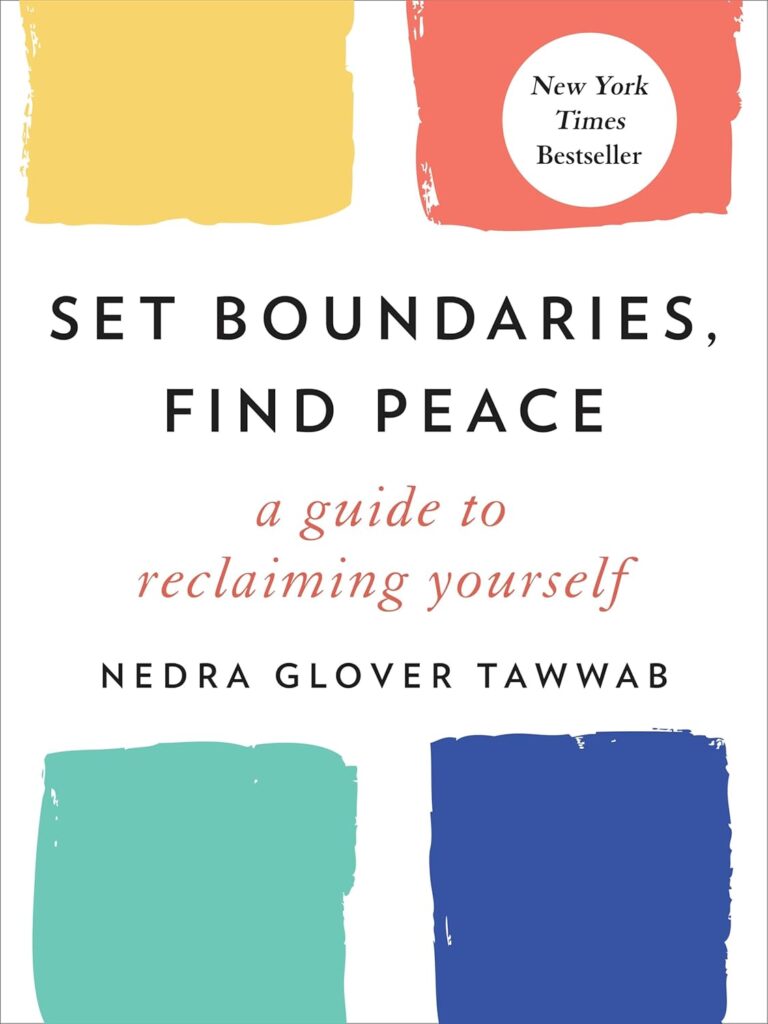
- 📖 Set Boundaries Find Peace by Nedra Tawwab — my absolute first recommendation for anyone starting this work. Tawwab writes with clarity, warmth, and zero judgment. The most practical and accessible boundary book I know. Clients who read this consistently say it changed how they see their relationships entirely.
- 📖 Boundaries by Dr Henry Cloud and Dr John Townsend — the foundational text on boundaries in relationships and family systems. Particularly resonant for readers with a faith background. Has helped millions of people understand that having limits is not incompatible with love.
- 📖 Adult Children of Emotionally Immature Parents by Lindsay Gibson — essential reading for anyone whose need for family boundaries stems from growing up with a parent who could not meet their emotional needs. Gibson’s work is clinically grounded and deeply validating.
- 📖 The Book of No by Susan Newman — practical, specific, and full of actual scripts for saying no in real situations. Particularly useful for people who know intellectually that they need to set limits but cannot find the words.
- 📓 The Boundary Boss Workbook by Terri Cole — a structured, exercise-based workbook for people who process better through writing than reading. I assign specific sections to clients who are actively working on boundary-setting in their family relationships.
These are Amazon affiliate links. Pragma Counsellors may earn a small commission if you purchase through them at no extra cost to you. I only recommend books I give to my own clients.
Frequently Asked Questions {#faq}for How to Set Boundaries With Family
Q: Is it okay to set boundaries with parents? Yes, unambiguously. The fact that someone gave you life or raised you does not grant them unlimited access to your time, energy, emotional resources, or decisions for the rest of your life. Loving your parents and having limits with your parents are not mutually exclusive. In fact, relationships with clear and honest limits are often more loving and more sustainable than relationships built on compliance and resentment.
Q: What if my family says I am being selfish? This accusation is almost universal when someone starts setting limits in a family system that has not expected them. It is worth examining whether there is any genuine truth in it self-reflection is always valuable. But in the vast majority of cases, “selfish” is the word families use for “different from what we expect.” Having limits is not selfishness. Selfishness is taking without regard for others. Having limits is knowing what you can genuinely give and being honest about it.
Q: How do I set boundaries with a parent who has a mental illness or disability? This is one of the most complex situations I work with because there is genuine love and genuine obligation involved, and the power dynamics are complicated by the parent’s vulnerability. The key principles remain the same: you can love someone and still have limits on what you can provide. You are allowed to protect your own mental health even when caring for someone who is unwell. Seeking support from a therapist, from other family members, from community services is not abandonment. It is recognising the limits of what one person can carry alone.
Q: My family does not respect my boundaries no matter what I say. What do I do? Stated limits that are not enforced with consistent action will not be respected. The question is not whether you have communicated the limit clearly enough it is whether you have followed through with consistent action when the limit is crossed. If you have done both consistently and the behaviour continues, you are in a more serious situation that warrants professional support and potentially a reassessment of the level of contact that is safe and healthy for you.
Q: Can setting boundaries actually improve family relationships? Yes and this is the part people are most surprised by. Relationships built on honest limits are more genuine, more sustainable, and ultimately more loving than relationships built on compliance and resentment. When you stop giving what you do not have, what you do give becomes real. When you stop saying yes out of fear, the yeses that remain are genuine. Many clients find that their family relationships become more honest and more connected after limits are established because the resentment that was poisoning the connection has been addressed at its source.

Parting Wisdom
That client who had not taken a holiday in four years she booked one. Fourteen days. A country she had wanted to visit for years.
Her mother called it selfish. Her sister did not speak to her for three weeks. One brother sent a message that was designed, with some craft, to make her feel guilty from the first word to the last.
She went anyway.
She sent me a photograph from a beach somewhere, with a message that said simply: “I had forgotten what it felt like to exist for myself.”
She had not destroyed her family by having limits. She had not destroyed the love. She had simply, for the first time in forty years, told the truth about what she could give and discovered that the truth, as uncomfortable as it was to speak, did not end the world.
Yours will not end either.
The people who truly love you will adjust. The relationships worth keeping will survive your honesty. And the life that is waiting on the other side of your no the life that belongs entirely to you has been there all along.
My question for you: What is the one limit you have been afraid to set with a family member and what have you been telling yourself is the reason you cannot?
You do not have to share the family member or the specific situation. Just the fear underneath it. Drop it in the comments below. I read every single comment personally and respond to all of them.
Ready to do this work with support? At Pragma Counsellors we work with clients navigating family boundaries, people-pleasing, and the complex relational patterns that family systems create in a space that is fully confidential and completely non-judgmental.
We offer a free 15-minute consultation. No pressure. No commitment. Online sessions available for clients in the US, UK, and internationally.
📍 Muhoho Avenue, South C, Nairobi, Kenya 📞 +254 752 448 315 / +254 784 684 422 📧 contact@pragmacounsellors.com 🌐 Online sessions available globally 👉 Book your free consultation here
