

By Peterson Micheni | Counselling Psychologist | Pragma Counsellors
Nobody tells you about the supermarket
They tell you about the first night. They tell you about the crying. They tell you to delete their number, unfollow them on social media, keep yourself busy, give it time. They tell you it gets better.
What they do not tell you is that six weeks later you will be standing in the cereal aisle of your local supermarket, completely fine, and then you will see the brand they always bought the one you used to mock them for and something in your chest will collapse so suddenly and so completely that you have to put your hand on the shelf to stay upright.
And that is not a breakdown. That is grief. That is what healing actually looks like from the inside not a steady upward line but a completely unpredictable landscape of fine and then not fine, better and then devastated, moving forward and then ambushed by a cereal box.
I have sat with hundreds of people navigating heartbreak across five years of clinical practice. I have watched brilliant, capable, strong people be completely undone by the end of a relationship and I have also watched those same people rebuild, reconnect with themselves, and eventually arrive at a version of their life that is genuinely better than what they lost.
The path between those two points is real. It is navigable. But it looks almost nothing like what the internet tells you it will look like.
This article is going to tell you the truth about healing after a breakup what it actually involves, what actually helps, and what nobody warned you about.
Table of Contents
- Why Heartbreak Physically Hurts — The Neuroscience Nobody Explains
- The Stages of Breakup Grief — And Why They Are Not Linear
- What Nobody Tells You About Healing After Heartbreak
- What Actually Helps — Evidence-Based Strategies That Work
- The Real Talk: What Makes It Worse
- When a Breakup Becomes Something More Serious
- Books That Have Genuinely Helped My Clients Heal
- FAQ
Why Heartbreak Physically Hurts — The Neuroscience Nobody Explains {#neuroscience}
The first thing I tell clients who come to me after a breakup is this: you are not being dramatic. What you are experiencing is physiologically real.
Heartbreak activates the same neural pathways as physical pain. A landmark study by Ethan Kross at the University of Michigan placed participants in an fMRI scanner and asked them to view photographs of their ex-partner immediately after a breakup. The brain regions that lit up were identical to those activated by physical pain stimuli. The language of heartbreak it hurts, I am in agony, I feel broken, is not metaphor. It is neurological description.
The reason romantic relationships produce such powerful pain when they end is rooted in attachment neurobiology. Humans are a pair-bonding species. Long-term intimate relationships activate the same attachment systems that bonded us to our caregivers in infancy systems that are governed by oxytocin, dopamine, and the opioid pathways. A relationship provides a consistent source of neurochemical regulation. When it ends, the brain experiences something functionally similar to withdrawal.
This is why the first weeks after a breakup feel so physically destabilising. Sleep disruption. Loss of appetite or compulsive eating. Difficulty concentrating. Physical chest pain. Fatigue. These are not signs of weakness or excessive sensitivity. They are the predictable neurobiological consequences of losing a primary attachment figure and the neurochemical regulation that relationship provided.
Understanding this matters for one important reason: you cannot think your way through withdrawal. You cannot logic yourself out of neurobiological pain. The cognitive strategies come later. In the acute phase, what the nervous system needs most is gentleness, connection, and time.

The Stages of Breakup Grief — And Why They Are Not Linear {#stages}
You may have heard of the five stages of grief, denial, anger, bargaining, depression, acceptance originally described by Elisabeth Kübler-Ross. They have been widely applied to relationship loss, and while they provide a useful framework, I want to be honest about their limitations.
Grief is not a staircase. It does not proceed in an orderly sequence from stage one to stage five with a clear arrival point. Real grief, including breakup grief, is more like weather. Unpredictable. Sometimes calm, sometimes violent. Sometimes two states at once. Sometimes looping back to a stage you thought you had already passed through.
In my counselling experience, breakup grief tends to involve several recurring emotional territories rather than discrete stages.
Shock and disbelief, even when the breakup was expected, even when you initiated it, there is frequently a period of unreality. The relationship occupied so much cognitive and emotional space that its absence creates a strange, hollow quality to daily life.
Yearning and preoccupation — the persistent, intrusive thinking about the person. Replaying conversations. Reviewing what went wrong. Checking their social media. Imagining them in their new life. This preoccupation is distressing and also neurologically normal, the brain is processing the loss of an attachment figure through exactly the same mechanisms it uses to process any significant loss.
Anger, at them, at the situation, at yourself, at the waste of time and investment. Anger in grief is healthy and important and frequently suppressed, particularly by people who identify as “not angry people” or who believe the relationship ending was their fault.
Sadness, the pure, clean sadness of missing someone who mattered. This is the stage people expect and it is often less straightforward than anticipated, sometimes arriving weeks after the breakup rather than immediately, sometimes mixed with other emotions in ways that make it hard to identify clearly.
Reconstruction, the gradual, nonlinear rebuilding of a life and identity that had been shaped around the relationship. This is the stage that takes the longest and receives the least attention in mainstream breakup advice.
The cereal aisle moment I described at the beginning happens in the reconstruction phase. You are genuinely moving forward, and then something ambushes you. That ambush is not regression. It is a normal feature of grief processing. It means the healing is happening, not that it has stopped.
What Nobody Tells You About Healing After Heartbreak {#nobody-tells}
1. It Will Probably Take Longer Than You Think Is Acceptable
Research on relationship dissolution suggests that recovery from a significant relationship takes, on average, significantly longer than the cultural narrative suggests. A study published in the Journal of Positive Psychology found that most people begin to feel meaningfully better approximately eleven weeks after a breakup, but that full psychological recovery from a long-term relationship can take considerably longer.
We live in a culture that is extremely uncomfortable with grief that extends past a few weeks. People around you will stop asking how you are. They will start suggesting you get back out there. They will express subtle or not so subtle impatience with your continued suffering.
Please ignore them. Your grief has its own timeline and it is not obligated to match anyone else’s comfort level.
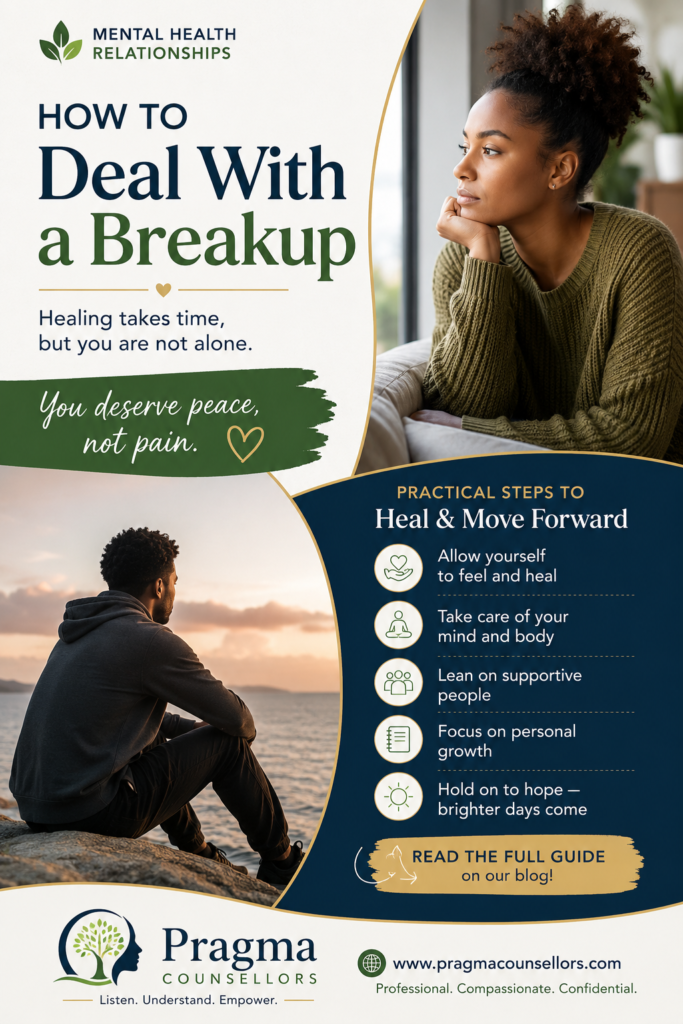
2. You Are Not Just Grieving the Person — You Are Grieving Everything They Represented
This is the piece of breakup grief that most people have never had named for them, and it is one of the most important things I discuss with clients.
When a relationship ends, you are not only grieving the person. You are grieving the future you had planned. The version of yourself that existed in that relationship. The life you had built or were building together. The routine, the inside jokes, the shared understanding of the world. The sense of being known by someone. The role of partner. The family they might have become.
These secondary losses, what clinicians sometimes call the shadow losses of grief, are often more numerous and more painful than the primary loss itself. Naming them individually is one of the most important steps in healing.
I ask clients: write down everything you have lost alongside the person. Not just them, everything. The holidays you had planned. The friend group you shared. The dog that now lives with them. The version of Christmas that no longer exists. The future children you had quietly named in your head.
Naming it all does not make it worse. It makes it grieve-able. And only what is named can be properly mourned.
3. Healing Is Not a Straight Line and the Bad Days Are Not Evidence of Failure
I have said this before in this article and I am saying it again because it is the thing I most frequently have to repeat in therapy.
A bad day three months in is not evidence that you are not healing. It is not evidence that you will never heal. It is not evidence that the relationship was right after all. It is a bad day. The brain processes grief in waves, not in a steady progression, and the waves become less frequent and less overwhelming over time but they do not disappear on schedule.
4. The Urge to Get Back Together Is Not Always About Love
One of the most important and least comfortable things I tell clients is this: the desperate urge to reconnect with an ex-partner is not always or even usually about love for that specific person. It is frequently about the need for relief from withdrawal symptoms. It is the neurochemical equivalent of reaching for the substance when the absence becomes unbearable.
This does not mean the love was not real. It means that love and neurobiological dependency are not the same thing, and distinguishing between them is important before making any decisions about contact or reconciliation.
5. Who You Are Without This Relationship Is a Question Worth Sitting With

Long-term relationships shape identity. The longer the relationship, the more of yourself was defined in relation to another person. When it ends, the question “who am I now?” is not a crisis. It is an invitation.
I have watched clients emerge from painful breakups as more themselves than they had been in years, reconnecting with interests they had abandoned, friendships they had neglected, ambitions they had quietly shelved. The relationship had not been bad necessarily. It had simply occupied so much space that other things had been crowded out.
The question of who you are without this relationship is one of the most important questions a breakup creates. It deserves to be approached with curiosity rather than terror
What Actually Helps — Evidence-Based Strategies That Work {#what-helps}
1. Allow the Grief — Do Not Manage It Into Silence
The single most counter-productive thing I see people do after a breakup is attempt to bypass the grief through constant activity, forced positivity, or immediate dating. Grief that is not processed does not disappear. It goes underground, and it surfaces later in unexpected and often more destructive ways.
Cry when you need to cry. Talk about it when you need to talk about it. Sit with the sadness when it comes rather than immediately reaching for a distraction. This is not wallowing. This is grief doing its necessary work.
2. Reach Out — Even When You Do Not Want To
Isolation and heartbreak form a particularly vicious cycle. The pain of the loss produces a withdrawal instinct, the desire to stay home, to cancel plans, to stop reaching out. That withdrawal deepens the pain by removing the connection that is one of the most powerful natural antidepressants available.
Reach out to the people in your life, not necessarily to talk about the breakup, but to be with other humans. Presence and connection are healing regardless of the content of the interaction.
If your people-pleasing pattern makes it difficult to reach out, if asking for support feels like a burden you cannot impose, please read that article alongside this one. The inability to receive support is one of the things that most prolongs breakup suffering.
3. Implement a Thoughtful No-Contact Period
This is not about punishing your ex. It is about giving your nervous system the space it needs to begin recalibrating without the constant reactivation of the attachment that contact produces.
Every text exchange, every social media check, every accidental meeting restarts the neurochemical cycle and delays the recalibration. A deliberate, self-compassionate no-contact period, not forever, not from cruelty, but for now, is one of the most evidence-supported recommendations in the breakup recovery literature.
4. Write — Extensively and Without Editing
Expressive writing about emotional experiences has been studied extensively by psychologist James Pennebaker. His research consistently shows that writing about painful experiences, without censorship, without structure, just following the thoughts reduces distress, improves immune function, and accelerates psychological processing.
Write about the relationship. Write about what you lost. Write about what you feel. Write about what you are afraid of. Write without any goal except externalising what is inside.
5. Reintroduce the Things That Belonged to You Before the Relationship
One of the most healing things a person can do after a significant breakup is deliberately reconnect with the person they were before the relationship began. The interests, the friendships, the habits, the ambitions that were yours before they were shaped by partnership.
This is not about going backwards. It is about reconnecting with a self that predates the relationship and discovering which parts of that self are still there, still intact, still interested in living.
6. Consider Therapy — Particularly If the Relationship Was Toxic
If the relationship you have left was emotionally abusive, narcissistically driven, or characterised by toxic patterns, please do not try to heal from it alone. These relationships produce specific psychological damage to self-worth, to reality testing, to attachment security that requires targeted therapeutic work. The grief of leaving them is complicated by trauma bonding, by the gaslighting that makes you question your own experience, and by the loss of an identity that was systematically dismantled.
Individual therapy is not a luxury after these relationships. It is the appropriate level of intervention.
The Real Talk: What Makes It Worse {#real-talk}
Immediately replacing them. Jumping into a new relationship or a series of dates within weeks of a significant breakup is one of the most consistently unhelpful things I see not because there is a rule about timing, but because it prevents the internal processing that needs to happen. You carry the unprocessed grief and attachment patterns into the new situation, where they create confusion, premature intensity, or an inability to be genuinely present with someone new.
Obsessive social media surveillance. Checking their profile. Looking at who is liking their posts. Examining photographs for evidence of who they are seeing. This behaviour maintains the neurochemical connection to the person rather than allowing it to recalibrate. It also exposes you to information you are not ready to receive, in a context where you have no ability to manage the emotional impact. Mute. Unfollow. Not because you hate them. Because you are healing.
The “closure” conversation. I am going to be frank about something that the breakup advice industry almost universally gets wrong. In most cases, the closure conversation the one where you go back to ask all the questions and get the explanations and finally understand does not produce closure. It produces reactivation. Real closure is almost never something another person can give you. It is something you arrive at internally, through the grief process, over time.
Telling yourself you should be over it by now. There is no “by now” in grief. The timeline is yours and it is not subject to other people’s expectations or your own judgments about what it should look like.
Using alcohol or substances to manage the pain. I understand the logic. The pain is acute and alcohol temporarily blunts it. But alcohol is a depressant that compounds emotional pain in the medium term and disrupts the sleep that is essential to grief processing. If you are drinking significantly more than usual since the breakup, please bring that to a professional conversation.
When a Breakup Becomes Something More Serious {#serious}
Most breakup grief, however painful, resolves over time without clinical intervention. But there are presentations that warrant professional attention.
Please seek support if you are experiencing:
- Persistent low mood that is not lifting after several months and is affecting your ability to function at work or maintain basic self-care
- Thoughts of self-harm or of not wanting to be alive
- Significant weight loss or an inability to eat over a sustained period
- Complete social withdrawal that has lasted more than a few weeks
- Substance use that has increased significantly since the breakup
- Intrusive, obsessive thoughts about the ex-partner that feel outside your control
- A pattern of depression developing that predates the breakup or has been triggered by it
Heartbreak that crosses into clinical depression, complex grief, or trauma responses requires clinical support. Receiving that support is not an overreaction. It is an appropriate response to a real clinical need.
Books That Have Genuinely Helped My Clients Heal {#books}
- 📖 Getting Past Your Breakup by Susan Elliott — the most comprehensive and clinically grounded breakup recovery book I know. Elliott writes from both professional expertise and personal experience. Structured, practical, and genuinely useful for people who want a framework for the recovery process.
- 📖 It’s Called a Breakup Because It’s Broken by Greg Behrendt — for those moments when you need someone to be warmly, kindly honest with you about why going back is not the answer. Behrendt writes with humour and zero judgment. A good read for the acute phase.
- 📖 Whole Again by Jackson MacKenzie — specifically for people recovering from toxic or narcissistic relationships. MacKenzie’s account of rebuilding identity and self-worth after relational trauma is the most helpful I have found for this specific presentation.
- 📖 The Body Keeps the Score by Bessel van der Kolk — for breakups that involved significant trauma. Van der Kolk’s work on how trauma lives in the body and what is required to heal it, is essential reading for anyone emerging from a relationship that was genuinely harmful.
- 📓 The Five Minute Journal — for the reconstruction phase specifically. Five minutes of structured morning intention and evening reflection provides a gentle daily anchor during a period when the days can feel formless and purposeless. Simple, effective, and actually usable when energy is low.
These are Amazon affiliate links. Pragma Counsellors may earn a small commission if you purchase through them at no extra cost to you. I only recommend books I give to my own clients.
Frequently Asked Questions about How to Deal With a Breakup
Q: How long does it take to get over a breakup? Research suggests that most people begin to feel meaningfully better around eleven weeks after a breakup but this varies enormously based on the length and intensity of the relationship, the circumstances of the ending, and the individual’s attachment history. A long-term relationship or a particularly painful ending may take considerably longer. The more important question is not “how long” but “am I processing this or am I avoiding it?” Avoidance extends the timeline significantly.
Q: Is it normal to still love someone after they hurt you? Completely. Love and pain coexist in breakup grief in ways that are confusing and completely normal. The love does not invalidate the hurt and the hurt does not eliminate the love. What matters is whether the love is sufficient reason to return to a situation that was causing you harm and that is a question worth examining carefully, ideally with professional support, rather than in the acute pain of the immediate post-breakup period.
Q: Should I try to be friends with my ex? In my clinical experience, friendship with an ex works in a minority of cases and in specific conditions when both people have genuinely processed the grief of the relationship ending, when there is no residual romantic feeling or hope of reconciliation on either side, and when sufficient time has passed. Attempting friendship immediately after a breakup almost always delays healing for at least one party and frequently for both. The friendship question is one for much later not for the recovery phase.
Q: Why do I miss someone who was bad for me? Because missing someone is a neurobiological experience, not a rational assessment of whether they deserved you. The attachment system does not evaluate character. It responds to familiarity, to the neurochemical regulation the relationship provided, and to the loss of a primary attachment figure, regardless of whether that figure was consistently kind. The missing is real and it is not evidence that the relationship was right. It is evidence of how powerfully human attachment works.
Q: How do I stop thinking about my ex? Attempts to suppress thoughts of an ex telling yourself not to think about them, reliably increase the frequency of those thoughts through the same mechanism as any thought suppression. The more effective approach is to allow the thoughts without engaging with them to notice them, to acknowledge the grief they represent, and to gently redirect attention without fighting the thought itself. Over time, with consistent application of this approach and with the grief being properly processed rather than suppressed, the frequency and intensity of intrusive thoughts naturally diminishes
Parting Wisdom
The cereal aisle moment will happen. Maybe it will be a song. Maybe it will be a restaurant you drove past. Maybe it will be something completely absurd, a specific quality of light on a specific kind of afternoon that takes you back to a specific day you did not know you had memorised.
When it happens, please do not interpret it as evidence that you are not healing. Please do not interpret it as evidence that you will never get past this. Please do not interpret it as evidence that you made the wrong choice.
It is just grief doing what grief does, arriving when it is ready rather than when you are ready, in the forms it chooses rather than the forms you would prefer.
The people I have watched heal most fully from heartbreak are not the ones who managed the grief most efficiently. They are the ones who let it move through them, who cried when they needed to cry, who talked about it when they needed to talk, who allowed themselves to be genuinely devastated without rushing themselves toward being fine.
And then one day, not dramatically, not all at once, but genuinely, they were better. Not the same as before. Better. Themselves in a fuller, more honest, more self-aware version than they had been in the relationship or before it.
That version of you is on the other side of this. It is real and it is waiting.
My question for you: What was your cereal aisle moment, the unexpected, completely ordinary thing that ambushed you? You do not have to share what it was specifically. Just that it happened.
Drop it in the comments below. I read every one personally and respond to all of them. And knowing you are not the only one who has stood in a supermarket trying to hold it together might be exactly what someone else needs today.
Ready to navigate this with professional support? At Pragma Counsellors we work with clients through heartbreak, relationship grief, and the patterns that relationships leave behind, in a space that is fully confidential and completely non-judgmental.
We offer a free 15-minute consultation. No pressure. No commitment. Online sessions available for clients in the US, UK, and internationally.
📍 Muhoho Avenue, South C, Nairobi, Kenya 📞 +254 752 448 315 / +254 784 684 422 📧 contact@pragmacounsellors.com 🌐 Online sessions available globally 👉 Book your free consultation here
