

By a Counselling Psychologist Pragma Counsellors, Nairobi
Depression in Men!?
He came to my office on a Tuesday afternoon. Smart shoes. Pressed shirt. Big smile when he greeted the receptionist.
He sat down. I asked him how he was doing.
He stared at the floor for a long time.
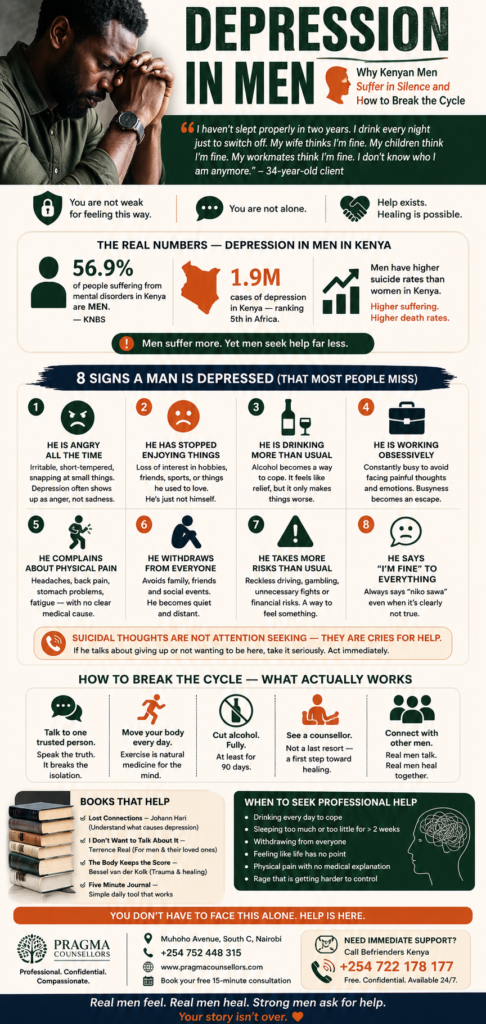
Then he said: “I haven’t slept properly in two years. I drink every night just to switch off. My wife thinks I’m fine. My children think I’m fine. My workmates think I’m fine. I don’t know who I am anymore.”
He was 34. He had never told anyone any of that before. Not one person.
That man is not unusual. In my five years as a counselling psychologist, I have sat with versions of him more times than I can count. Successful men. Hard-working men. Funny men. Men who are falling apart so quietly that nobody around them has any idea.
This article is for them. And for everyone who loves a man who might be suffering in silence right now.
Table of Contents
- The Real Numbers — Depression in Men in Kenya
- Why Depression in Men Looks Different
- The “Man Up” Culture That Is Killing Men
- 8 Signs a Man Is Depressed (That Most People Miss)
- What Causes Depression in Men in Kenya
- The Real Talk: What Makes It Worse
- How to Break the Cycle — What Actually Works
- Books and Resources That Help
- When to Seek Professional Help
- FAQ
The Real Numbers — Depression in Men in Kenya {#numbers}
Let me give you the facts straight.
According to the Kenya National Bureau of Statistics, 56.9% of people suffering from mental disorders in Kenya are men compared to 43.1% women. Men suffer more. Yet men seek help far less. That gap is not a coincidence. It is the direct result of a culture that tells men that pain is weakness.
Kenya has approximately 1.9 million cases of depression, ranking 5th in Africa. And according to the KNBS, men have higher suicide rates than women in Kenya. Higher rates of suffering. Higher rates of death. And yet the mental health conversation in Kenya is almost entirely focused on women.
I find that deeply frustrating. And I think it needs to change, starting with this article.
Why Depression in Men Looks Different {#looks-different}
Here is something most people do not know: depression in men does not always look sad.
When most people picture depression, they imagine someone who cannot get out of bed. Someone crying. Someone obviously broken. That image stops men from recognising depression in themselves, because many depressed men are getting up every single day. They are going to work. They are making jokes. They are providing.
They just feel completely empty inside.
In my practice, male depression usually shows up as anger, not sadness. Irritability. Short fuse. Snapping at the children for small things. Road rage that feels disproportionate. A general restlessness ,like the man cannot sit still, cannot relax, cannot just be.
It also shows up as physical symptoms. Headaches. Back pain. Stomach problems. Fatigue that no amount of sleep fixes. Men are far more likely to go to a doctor about a physical symptom than to say “I feel sad.” So they see three different doctors about their back pain before anyone asks how they are doing emotionally.
The Signs and symptoms of depression in men are often not in line with what we traditionally expect — and that mismatch is one of the main reasons male depression goes undiagnosed and untreated for years.
The “Man Up” Culture That Is Killing Men {#man-up}
I will be blunt about this because I am tired of tiptoeing around it.
The Kenyan version of manhood, tough, stoic, self-reliant, never vulnerable, is genuinely costing men their lives.
From childhood, Kenyan boys receive a very clear message: crying is for girls. Showing fear is weakness. Talking about feelings is not what men do. A Standard article from 2025 described it perfectly: “Men are taught from a young age that vulnerability is weakness, that speaking about fear, sadness, or mental distress is unmanly.“
I saw this in my own extended family. An uncle of mine, big man, loud laugh, always the one cracking jokes at family gatherings, died at 52. Heart attack, they said. Years later, his wife told me he had been drinking a bottle of whisky every night for the last decade. He had lost his business quietly. He had been ashamed to tell anyone. He had never spoken to a counsellor, a pastor, a friend, no one. He handled it alone. Silently. Until his body gave out.
That is the culture I am talking about. And it is not strength. It is a slow death by silence.
Traditional masculinity norms, stoicism, emotional suppression, and self-reliance, actively discourage men from seeking help and make emotional suppression the default way of coping. A survey by Priory found that 40% of men have never spoken to anyone about their mental health. Not a partner. Not a friend. Not a professional. Nobody.
8 Signs a Man Is Depressed (That Most People Miss) {#signs}
These are the signs I look for in my male clients, because the obvious ones almost never come first.
1. He is angry all the time Not sad. Angry. Snapping at small things. Short-tempered with the children, the wife, the driver who cut him off. Persistent irritability in a man is often depression wearing a disguise. I call it depression with a hard hat on.
In my experience, the men who come to me described as “difficult” or “aggressive” by their families are often the most depressed people in the room. The anger is protection. Underneath it is enormous pain.
2. He has stopped enjoying things he used to love He used to watch football every weekend. Now the TV is off. He used to go out with friends. Now he cancels everything. He used to joke around. Now he is quiet.
This is called anhedonia, the loss of pleasure in things that used to bring joy. It is one of the clearest signs of depression. When a man stops being himself, pay attention.
3. He is drinking more than usual I have found that alcohol is the number one self-medication tool for depressed men in Kenya. Not drugs. Not sleeping pills. Alcohol. Because it is socially acceptable. Because it is everywhere. Because nobody questions a man who drinks.
Males are far more likely to self-medicate with alcohol and other substances than to seek professional help. The drinking feels like a solution. It is actually an accelerant, making the depression worse with every glass.
4. He is working obsessively This one surprises people. Working constantly looks like ambition. It looks like a good provider, a focused man, a dedicated professional.
Sometimes it is. But sometimes a man who cannot stop working is a man who is terrified to stop ,because stopping means sitting alone with thoughts he cannot face. Busyness is a very effective way to avoid depression for a while. Just not forever.
5. He complains about physical pain Back pain. Headaches. Stomach problems. Fatigue. Men with depression visit doctors for physical symptoms far more than they visit counsellors for emotional ones. I have had male clients who went to four different hospitals before anyone thought to ask about their mental health.
If a man in your life has unexplained physical symptoms that no doctor can properly explain, depression is worth considering.
6. He withdraws from everyone He stops calling family. He skips social events. He becomes an island. Men with depression often withdraw quietly, not dramatically. Nobody notices until the withdrawal is almost complete.
7. He takes more risks than usual Reckless driving. Gambling. Starting unnecessary fights. Taking financial risks that make no sense. Risk-taking behaviour in men is often a sign of depression, an unconscious way of feeling something when everything inside feels numb.
8. He says “I’m fine” to everything
This might be the most Kenyan sign on this list. “Niko sawa.” “I’m managing.” “I’m okay.” When a man has one answer for every question about how he is doing, no matter what is actually happening in his life, that fixed smile deserves a second look.

Quick side note on suicidal thoughts
“If a man in your life starts making comments about life not being worth it, about people being better off without him, or about not seeing a future take it seriously. These are not dramatic statements. They are cries for help from a person who has run out of other ways to communicate their pain. Act immediately. See the resources section below.“
What Causes Depression in Men in Kenya {#causes}
Depression does not come from nowhere. In my practice, these are the most common triggers I see in Kenyan men:
Financial pressure and unemployment — the expectation that a man must provide, and the shame when he cannot, is enormous. Economic instability, unemployment, and the pressure to provide for families are major stressors contributing to mental health issues in Kenyan men. When a man loses his job or his business fails, he does not just lose income. He loses his identity.
Relationship breakdown — divorce, separation, being pushed out of his children’s lives. The research is clear that men are less likely to maintain social support networks after a relationship ends, leaving them isolated at exactly the moment they most need connection.
Unprocessed trauma — childhood trauma, violent experiences, witnessing terrible things. Men are rarely given permission to process trauma. They are told to move on. The unprocessed trauma sits inside them for years, quietly rotting.
The pressure to “sort it out” — Kenyan men are expected to be problem-solvers. When the problem is inside their own mind, that expectation becomes a trap. How do you fix something you are not allowed to admit is broken?
The Real Talk: What Makes It Worse {#real-talk}
After five years in this work, here is my honest list of things that make male depression significantly worse and that I wish more people would stop doing.
Telling him to pray harder. I am a person of faith and I have enormous respect for the role of spirituality in healing. But using prayer as a substitute for treatment is like telling a man with a broken leg to pray instead of seeing a doctor. Faith supports healing. It does not replace professional mental health care.
Telling him to “be strong for the family.” This sentence has probably caused more damage to Kenyan men’s mental health than any other. A man who is already depleted does not need to be told to give more. He needs permission to receive.
Waiting for him to ask for help. Depressed men almost never ask for help directly. The way they ask is through changed behaviour the drinking, the withdrawal, the anger. Waiting for a man to say “I need help” is like waiting for someone drowning to politely request a life jacket. Act on what you see. Do not wait for the words.
Alcohol as the solution. I have said it before and I will say it again. Alcohol makes depression worse. Always. It feels like relief. It is fuel on a fire.
How to Break the Cycle — What Actually Works {#break-cycle}
These are the strategies I share with male clients and their families that actually make a difference.
1. Name what you are feeling — out loud, to one person
The single most powerful thing a depressed man can do is tell one safe person the truth. Not on social media. Not in a group. One person. A brother. A close friend. A counsellor. The act of naming the pain out loud reduces its power significantly. It also breaks the isolation that makes depression spiral.
2. Move your body every single day
I am very direct about this with my male clients: exercise is not optional when you are depressed. It is medicine. Research consistently shows that regular physical activity reduces depression symptoms as effectively as medication for mild to moderate depression. A 30-minute walk, a run, a gym session, football, whatever the man will actually do. Every day. Non-negotiable.
3. Cut alcohol. Fully. At least for 90 days.
I know this is the hardest one. But if a man is drinking to manage his emotions, the alcohol must go before anything else can properly work. I have seen men spend years in therapy with limited progress, and then quit drinking and transform in three months. The alcohol was blocking everything.
4. See a counsellor — not as a last resort, but as a first step
Counselling is not for people who are completely broken. It is for people who are carrying something heavy and need help putting it down. In my practice, the men who make the most progress are the ones who came in before crisis point, not after. Early support changes everything.

Bonus: Talk to other men who have been through it
The most powerful thing I have seen in male mental health recovery, more powerful than any technique I use in a session is a man discovering that another man he respects has been through exactly what he is going through. The peer connection breaks the shame instantly. Look for men’s mental health groups, church brotherhood programmes, or community support networks. They exist. Seek them out.
Books and Resources That Help {#resources}
These are books I recommend to male clients and their families. I have read every one of them myself.
- 📖 Lost Connections — Johann Hari — the best explanation of what actually causes depression that I have ever read. Not clinical. Deeply human.
- 📖 I Don’t Want to Talk About It — Terrence Real — specifically about male depression. Written by a therapist. Incredibly eye-opening for both men and the people who love them.
- 📖 The Body Keeps the Score — Bessel van der Kolk — for men whose depression is rooted in trauma. Life-changing.
- 📓 Five Minute Journal — the simplest daily journaling tool I have found. Most men will not keep a long diary. This one takes five minutes. It works.
These are Amazon affiliate links. A small commission may go to Pragma Counsellors if you purchase through them, at no extra cost to you. I only recommend books I give to my own clients.
When to Seek Professional Help {#help}
My rule is simple: do not wait for a crisis. But here are the clear signs that say now, not later:
- Drinking every day to cope
- Sleeping too much or barely sleeping at all for more than two weeks
- Withdrawing from everyone — family, friends, work colleagues
- Feeling like life has no point or that people would be better off without you
- Physical symptoms — pain, fatigue, that doctors cannot explain
- Rage that is getting harder to control
At Pragma Counsellors in Nairobi, we work with men navigating depression, burnout, relationship breakdown, and trauma. Our sessions are completely confidential. Nobody needs to know you came. What matters is that you do.
We offer a free 15-minute consultation — no commitment, no judgment. Just a conversation.
📍 Muhoho Avenue, South C, Nairobi 📞 +254 752 448 315 👉 Book your free consultation here
Frequently Asked Questions {#faqs}
Q: Is depression in men different from depression in women? Yes not in what it is, but in how it shows up. Men are more likely to show anger, irritability, and risk-taking behaviour. Women are more likely to show sadness and tearfulness. Because depression in men looks different, it is much more often missed or misdiagnosed.
Q: Can a man recover from depression without medication? Many men do especially with mild to moderate depression. Counselling, regular exercise, cutting alcohol, improved sleep, and strong social support can be very effective. For moderate to severe depression, medication may be needed alongside therapy. A mental health professional can help assess what is right for each person.
Q: How do I help a man I love who I think is depressed? Do not wait for him to ask for help he probably will not. Tell him specifically what you have noticed: “I’ve noticed you seem exhausted and withdrawn lately. I’m worried about you.” Offer to go with him to a first appointment. Do not minimise what he is going through. Do not tell him to be strong. Tell him you are there.
Q: Is counselling confidential in Kenya? Yes. A qualified counsellor is bound by professional confidentiality. What you share in a session stays in that room. At Pragma Counsellors, confidentiality is absolute — unless there is a risk to your life or someone else’s.
Q: Is it weak for a man to see a counsellor? I have been asked this question more times than I can count. My answer is always the same: it takes more courage to walk into a counsellor’s office and tell the truth than to keep pretending everything is fine. The men I have worked with who sought help are without exception stronger, not weaker, for having done it.

Parting Wisdom
That man in the pressed shirt who sat in my office on that Tuesday afternoon — he came back every week for four months. He stopped drinking. He started sleeping again. He told his wife the truth for the first time in years. She cried. He cried. They are still together.
He told me on his last session: “I spent ten years thinking that suffering alone was the manly thing to do. I wasted ten years.”
You do not have to waste yours.
The cycle breaks the moment one man decides to tell the truth. That man could be you. That man could be someone you choose to reach out to today.
My question for you: Do you know a man who is suffering in silence right now? Or have you been that man yourself? What finally made the difference?
Share your story or your question in the comments below. Your words might be exactly what someone needs to read today. I read and respond to every single comment personally.
