

By Peterson Micheni | Counselling Psychologist | Pragma Counsellors
Narcissistic Partner: How to Recognise One; She described the beginning of the relationship as the most intensely wonderful experience of her life.
He had pursued her like nobody ever had. Texts at midnight telling her she was extraordinary. Weekends planned down to the last detail. A level of attention that felt, at the time, like finally being truly seen.
Within six months she was walking on eggshells. Within a year she was apologising for things she had not done. Within two years she had stopped seeing her friends, stopped trusting her own memory, and started waking up at 3am with a hollow dread she could not name.
When she sat in my therapy room and I introduced the word narcissism, something shifted in her face. Not relief exactly. More like the particular exhaustion of someone who has been carrying a weight they could not identify and has finally been told its name.
Narcissistic abuse is one of the most searched mental health topics globally, and one of the most misunderstood. The word “narcissist” gets thrown around casually someone who posts too many selfies, someone who talks about themselves too much. But clinical narcissism is something far more specific, far more serious, and far more damaging than a personality quirk.
This article is going to tell you exactly what it looks like, why it is so hard to see from the inside, and most importantly why leaving feels so devastatingly impossible and what that says about you.
Table of Contents
- What Narcissistic Personality Disorder Actually Is — Beyond the Buzzword
- The Love Bombing Phase — Why It Feels So Real
- 12 Signs You Are With a Narcissistic Partner
- Narcissistic Abuse and Trauma Bonding — Why You Can’t Just Leave
- What a Narcissistic Relationship Does to Your Mental Health
- The Real Talk: The Things Nobody Warns You About
- How to Begin Healing — Whether You Stay or Leave
- Books That Have Genuinely Helped My Clients
- FAQ
What Narcissistic Personality Disorder Actually Is Beyond the Buzzword {#what-is}
Before anything else, I want to make an important clinical distinction.
Narcissistic Personality Disorder (NPD) is a diagnosable condition in the DSM-5. It is characterised by a pervasive pattern of grandiosity, a deep need for admiration, and a significant lack of empathy for others. It affects approximately 1–6% of the general population, with higher rates in men than women though women with NPD are frequently underdiagnosed because their presentation looks different.
However and this is critical you do not need to be in a relationship with someone who has a formal NPD diagnosis to be experiencing narcissistic abuse. Many people with significant narcissistic traits never receive a diagnosis. They may not meet the full clinical threshold. But the patterns they engage in the manipulation, the entitlement, the emotional cruelty, the control are just as damaging to the people in relationships with them.
Throughout this article I use the term “narcissistic partner” to refer to someone displaying a significant cluster of narcissistic traits, whether or not they have ever seen a psychologist. The experience of the person on the receiving end is what matters here.
What makes narcissism clinically distinct from ordinary selfishness or arrogance is its rigidity and its impact. A narcissistic person does not simply have moments of self-centredness. They have a fixed, pervasive pattern of relating to others as extensions of themselves sources of admiration, validation, and supply rather than as autonomous people with equal worth and legitimate needs.
If you have recognised patterns of emotional abuse in your relationship, narcissistic dynamics may well be part of what you are experiencing. The two frequently overlap.
The Love Bombing Phase , Why It Feels So Real {#love-bombing}
I want to spend time here because this is the part of the narcissistic relationship cycle that survivors feel most ashamed of and most confused by.
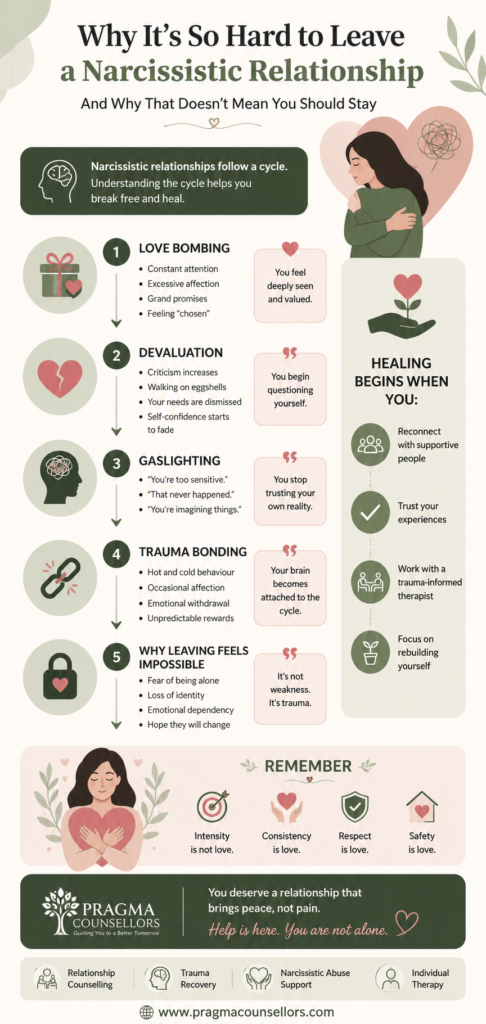
Love bombing is the term for the intense, overwhelming pursuit that characterises the beginning of many narcissistic relationships. It involves excessive flattery, constant attention, grand gestures, declarations of deep connection very early on, and a quality of being seen and known that feels almost supernatural in its intensity.
The reason it works so effectively is that it is, in many ways, real. The narcissistic person does feel a powerful pull toward you in this phase but what they are pulled toward is not you as a person. It is what you represent as a source of narcissistic supply. Your admiration, your attention, your growing attachment these feed something in them that requires constant replenishment.
I always tell clients this: the love bombing phase is not a lie that was performed on you. It is a phase that was genuinely experienced just by someone whose experience of connection is fundamentally different from what you were hoping for. That does not make you foolish for responding to it. It makes you human.
The love bombing phase typically ends or begins to crack when the narcissistic partner feels secure in your attachment. Once they are confident you are invested, the dynamic shifts. Criticism begins. The entitlement becomes visible. The empathy that appeared to be there reveals itself as performance. And by then you are already deeply attached to the person you met in those first months the one who made you feel extraordinary. You spend the rest of the relationship trying to get that person back.
12 Signs You Are With a Narcissistic Partner {#signs}
1. The Relationship Moved Extremely Fast in the Beginning
Love bombing creates artificial intimacy at an accelerated pace. Declarations of love within weeks. Talk of moving in together, getting married, having children in the first few months. An intensity that felt like destiny.
Fast-moving relationships are not automatically narcissistic. But when that initial intensity is followed by devaluation when the extraordinary attention is replaced by criticism and control the acceleration of the early phase takes on a different meaning in retrospect. It was not about connection. It was about securing supply.
2. Everything Is Always About Them
Conversations consistently return to their achievements, their grievances, their needs, their feelings. When you share something difficult a bad day, a worry, a hurt it is acknowledged briefly and then redirected to something about them. Your experiences exist primarily as prompts for their monologue.
When something good happens to you, there is a subtle or not so subtle diminishing of it. Your promotion is acknowledged with a comment about their own work. Your achievement is matched and exceeded. Your good news somehow becomes a vehicle for their narrative.
3. They Have No Accountability — Ever
Every conflict ends with you being the problem. Every mistake is reframed as your fault, your misunderstanding, your sensitivity. The narcissistic partner has an extraordinary ability to reverse the narrative of any situation so that they emerge blameless and you emerge responsible.
This is the DARVO pattern Deny, Attack, Reverse Victim and Offender and in a narcissistic relationship it operates constantly. You come to them with a genuine hurt. You leave the conversation apologising for having brought it up.
If you are also recognising people-pleasing patterns in yourself, it is worth exploring how much of that pattern developed or intensified within this relationship. Narcissistic partners are extraordinarily effective at training their partners into compliance.
4. Extreme Reactions to Any Perceived Criticism

What clinicians call narcissistic injury the narcissistic partner’s response to any feedback, disagreement, or challenge is frequently disproportionate and frightening. A mild observation becomes a full-scale attack. A gentle question becomes evidence of your fundamental disrespect for them.
The intensity of these reactions serves a function: it trains you to stop bringing things up. After enough experiences of a small concern triggering a major explosion, you learn to manage your own feelings silently rather than risk the fallout. This is precisely the outcome the dynamic requires.
5. A Different Face for Different Audiences
One of the most disorienting features of narcissistic relationships is the radical difference between the private and public person. In public with friends, colleagues, family they are charming, generous, funny, admired. The disparity between who they are in public and who they are at home is so extreme that victims frequently struggle to get people to believe their experience.
“But he’s so lovely.” “She’s always so kind when I see her.” “He doesn’t seem like that at all.”
I have heard this from more clients than I can count. The public persona is not a performance in the way that word implies a conscious strategy. It is a presentation that serves the narcissistic need for admiration and is simply unavailable in private where the supply mechanism is different.
6. Devaluation — The Shift From Pedestals to Contempt
After the love bombing phase, the narcissistic partner typically begins a process of devaluation. The qualities they once celebrated in you become targets for criticism. The independence they claimed to admire becomes threatening. The confidence they were drawn to becomes arrogance in their retelling.
Devaluation can be subtle a constant undercurrent of mild contempt, eye-rolls, dismissive comments or dramatic. Either way, its effect is the same: the person who was once made to feel extraordinary begins to feel inadequate, confused, and desperate to restore the version of themselves that was once loved.
7. Gaslighting Is a Daily Experience
“That never happened.” “You are remembering it wrong.” “You are far too sensitive.” “I never said that.”
Gaslighting in a narcissistic relationship is not occasional. It is structural. It is the mechanism by which the narcissistic partner maintains their version of reality as the authoritative one and it is devastatingly effective because it targets your trust in your own perception.
Many clients in narcissistic relationships begin keeping secret records journals, screenshots, saved messages just to verify to themselves that their memory is accurate. That level of self-doubt is not a personality trait. It is the direct result of sustained gaslighting. I discuss this pattern in depth in my article on what emotional abuse actually is it is worth reading alongside this one.
8. They Triangulate — Using Other People as Weapons
Triangulation involves introducing a third party into the relationship dynamic as a source of competition or comparison. Your partner mentions how attractive their colleague is. How their ex never complained the way you do. How their mother thinks you are difficult. How everyone else seems to understand them why can’t you?
The function of triangulation is to keep you off balance uncertain of your place, anxious about your worth, working harder to secure their approval. It is one of the most deliberately destabilising tools in the narcissistic relationship toolkit.
9. Intermittent Reinforcement — the Hot and Cold Pattern

This is the mechanism at the heart of why narcissistic relationships are so addictive and so hard to leave.
Intermittent reinforcement describes a pattern where reward is unpredictable sometimes your partner is warm, loving, and almost like the person from the love bombing phase. Other times they are cold, contemptuous, or cruel. You never know which version you are going to encounter.
Research in behavioural psychology shows that intermittent reinforcement creates stronger attachment than consistent reward. It is the same mechanism that makes gambling addictive. The unpredictability of the reward keeps you seeking it more desperately and the occasional return of warmth feels more powerful than if the warmth were constant.
10. Your Needs Are Treated as Inconveniences
In a narcissistic relationship, your emotional needs, physical needs, and relational needs are consistently treated as excessive, demanding, or inconvenient. You learn to need less. To ask for less. To expect less. You shrink your requirements down to almost nothing and still find they are too much.
11. They Cannot Tolerate Your Success or Happiness
When things go well for you a promotion, a compliment from someone, a personal achievement there is no genuine celebration from your partner. There is deflection, competition, subtle undermining, or a conspicuous absence of joy on your behalf.
A narcissistic partner needs to be the primary source of your positive feelings and needs to be the most successful, admired person in the relationship. Your independent happiness is a threat to both of those requirements.

12. You Have Completely Lost Yourself
You do not remember what you used to enjoy. Your friendships have eroded. Your confidence in your own perceptions has been so thoroughly undermined that you genuinely do not know what is real anymore. You have spent so much time managing this one person’s moods and needs that your own identity has quietly disappeared.
This loss of self is, in my clinical experience, the most lasting and most painful effect of a narcissistic relationship and the one that requires the most sustained therapeutic work to rebuild.
Narcissistic Abuse and Trauma Bonding — Why You Can’t Just Leave {#trauma-bond}
I want to address the question that partners of narcissists ask themselves and get asked by others most frequently.
Why don’t you just leave?
The answer is trauma bonding. And understanding it is the single most important thing for both the person in the relationship and the people who love them.
Trauma bonding is the powerful psychological attachment that forms in relationships characterised by cycles of abuse and intermittent affirmation. The neurological mechanism is identical to addiction. The unpredictable warmth of the narcissistic partner those moments when they are kind, when they seem like the person from the beginning, when the love feels real activates the brain’s dopamine reward system in the same way a drug does.
Leaving a trauma bond feels like withdrawal. The longing for the person is physical. The obsessive thinking is involuntary. The return to the relationship, even after significant harm, feels like relief in the same way that a relapse feels like relief to someone in addiction recovery.
Research from the Journal of Trauma and Dissociation confirms that trauma bonding significantly impairs a victim’s ability to accurately assess danger in their relationship and to sustain a decision to leave. This is not weakness. This is neurochemistry.
I also want to name the identity component. By the time someone is ready to leave a narcissistic relationship, they often do not know who they are anymore. Leaving requires a self to leave toward a life, an identity, a sense of what you want and the relationship has systematically dismantled all of those things. Leaving into nothing is terrifying.
If you are in this situation and recognising signs of a toxic relationship, please know this: the difficulty of leaving is not evidence that the relationship is right. It is evidence of how effectively it has worked on you.

What a Narcissistic Relationship Does to Your Mental Health {#mental-health}
The research on the psychological effects of narcissistic abuse is unambiguous and serious.
Complex PTSD is the most common diagnosis I see in survivors of narcissistic relationships. The repeated cycles of idealisation, devaluation, and discard combined with sustained gaslighting and emotional invalidation produce a trauma response that is distinct from single-incident PTSD and significantly harder to treat.
Severe anxiety — particularly hypervigilance, a constant state of alertness to threat is almost universal. The nervous system has been trained over years to monitor for danger. It does not simply stop doing that when the relationship ends.
Depression — the erosion of self-worth, the loss of identity, the grief for who you used to be all create the conditions for clinical depression. I discuss the signs of depression that go beyond sadness in another article — many of those signs show up directly in narcissistic abuse survivors.
Disordered attachment — the trauma bond creates attachment patterns that can affect every subsequent relationship. Survivors often find themselves drawn to familiar dynamics, misreading safe people as boring and intensity as love.
Profound self-doubt — perhaps the most pervasive and persistent effect. The gaslighting has done its work so thoroughly that many survivors spend years rebuilding their basic trust in their own perception.
The Real Talk: The Things Nobody Warns You About {#real-talk}
Recovery takes longer than you expect. Many clients leave a narcissistic relationship and assume that once they are out, they will feel better quickly. The reality is that the trauma bond does not dissolve at the moment of leaving. It can persist for months or years. You may find yourself longing for someone who was hurting you. That longing is not love. It is a neurochemical withdrawal that needs to be treated with the same seriousness as any other addiction.
You will question whether it was really that bad. This is one of the most disorienting features of narcissistic abuse recovery. Because the abuse was psychological rather than physical, and because the gaslighting trained you to doubt your perceptions, you will almost certainly go through phases of wondering whether you exaggerated, whether it was your fault, whether they were really that harmful. Keep your journal. Trust your records. Trust what your body remembers even when your mind tries to revise it.
People who did not see it will not believe you. The public persona of the narcissistic partner is often so convincing that people in your shared social network may defend them or question your experience. This is re-traumatising and it is one of the reasons survivors of narcissistic abuse feel so profoundly alone. You are not alone. Your experience is real.
No contact is almost always necessary — and harder than it sounds. Every contact with a narcissistic ex re-activates the trauma bond. Every message, every accidental meeting, every check of their social media feeds the cycle. No contact is not cruelty. It is medicine.
They will not change for the next person. One of the most painful thoughts that keeps people trapped is the fear that they will change for someone else that the person from the love bombing phase will return for the next relationship and you will have left your chance at that person. Research does not support this. The pattern is structural, not situational.

How to Begin Healing — Whether You Stay or Leave {#healing}
1. Work with a trauma-informed therapist
Not just any therapist. A trauma-informed therapist who has specific experience with narcissistic abuse and complex PTSD. The treatment approach is different from general anxiety or relationship counselling. EMDR, somatic therapy, and parts-based approaches like Internal Family Systems have the strongest evidence base for this specific type of relational trauma.
2. Rebuild your reality — slowly and deliberately
Keep a journal. Document your experiences. Practice trusting your perceptions in low-stakes situations — noticing when you are uncomfortable, naming what you observe, trusting your gut on small things. Rebuild the relationship with your own perception from the ground up.
3. Reconnect with people the relationship isolated you from
Isolation is a feature of narcissistic relationships. Reconnection is a feature of recovery. Reach out to the people you drifted from. You do not have to explain everything immediately. Just start the reconnection. Your support network is part of your recovery infrastructure.
4. Educate yourself — but watch the obsession point
Understanding what happened to you through reading and research is genuinely helpful. It gives language to experience, reduces self-blame, and validates what you went through. However I have seen clients get stuck in research endlessly consuming narcissism content as a way of staying connected to the relationship rather than healing from it. If the research is feeding rumination rather than resolution, it has stopped being healing and started being a different form of the bond.
5. Be patient with the grief
Leaving a narcissistic relationship involves grieving multiple things simultaneously the person you thought they were, the relationship you thought you had, the future you believed was possible, and the self you lost along the way. That grief is real and it deserves time and space and support.
If you are working through grief in other areas of your life alongside this, please do not try to carry it all alone.
Books That Have Genuinely Helped My Clients {#books}
These sit permanently in rotation in my therapy room recommendations.
- 📖 Should I Stay or Should I Go? by Lundy Bancroft — the most honest and non-judgmental guide to making the decision about leaving a difficult relationship. Bancroft writes without pressure and with enormous respect for the complexity of the situation.
- 📖 Psychopath Free by Jackson MacKenzie — specifically written for survivors of narcissistic and emotionally abusive relationships. MacKenzie writes from lived experience as well as research. Deeply validating for people who have felt their experience was not “bad enough.”
- 📖 Whole Again by Jackson MacKenzie — the recovery-focused companion to Psychopath Free. One of the best books I know on rebuilding identity and self-worth after leaving a toxic relationship.
- 📖 Why Does He Do That? by Lundy Bancroft — essential reading for understanding the psychology of controlling and abusive partners. Bancroft spent years working therapeutically with abusive men and writes with a clarity that cuts through every rationalisation.
- 📖 The Body Keeps the Score by Bessel van der Kolk — for understanding the somatic experience of trauma and why recovery requires more than cognitive insight. The most important book I have read on trauma in fifteen years of this work.
These are Amazon affiliate links. Pragma Counsellors may earn a small commission if you purchase through them at no extra cost to you. I only recommend books I give to my own clients.
Frequently Asked Questions Narcissistic Partner: How to Recognise One
Q: Can a narcissistic person love their partner? This is the question I am asked most often, and it deserves an honest answer. Research suggests that people with NPD experience something that functions like love particularly in the idealisation phase but that their capacity for the kind of consistent, empathic, other-centred love that sustains long-term healthy relationships is severely limited. Whether that constitutes love in the full sense is a philosophical question as much as a clinical one. What I can say is that whatever they feel, it does not protect their partner from harm.
Q: Is it possible to have a healthy relationship with a narcissist? With someone with full NPD and no insight, no not in my clinical experience. With someone with narcissistic traits who has genuine motivation to change and is engaged in sustained therapeutic work possible, but rare. Change requires a level of self-examination that is fundamentally uncomfortable for someone whose entire psychological architecture is built around avoiding that discomfort. I have seen it happen. It takes years of committed work and the partner must be able to maintain their own wellbeing independently throughout.
Q: Why do I miss them even though they hurt me? Because what you are experiencing is a trauma bond, which functions neurochemically like an addiction. The longing is real. The pain of the longing is real. But it is not evidence that the relationship was good for you it is evidence of how effectively the intermittent reinforcement worked on your brain. This is exactly what trauma-informed therapy addresses.
Q: How do I know if I am the narcissist in my relationship? The fact that you are asking this question is itself significant people with NPD typically have limited insight into their own patterns and rarely ask whether they are the problem. That said, if you recognise patterns of controlling behaviour, difficulty empathising with your partner’s experience, or a pattern of the world consistently being other people’s fault, individual therapy is the most honest and useful place to explore that.
Q: What is the no-contact rule and does it actually work? No contact means ending all communication and social media connection with a narcissistic ex. Research and clinical evidence strongly support it as a recovery tool every contact re-activates the trauma bond and makes recovery significantly harder. It works, but it requires sustained commitment and usually benefits from therapeutic support during the process.
Parting Wisdom
The woman I described at the beginning the one who had been made to feel extraordinary and then spent two years being quietly dismantled came back to see me eighteen months after leaving.
She was unrecognisable. Not in appearance. In the way she took up space in the room. She had opinions again. She laughed easily. She described a new relationship quiet and kind and completely undramatic — and said something I have never forgotten.
“I used to think calm felt boring. I didn’t realise I had confused anxiety for love.”
That sentence contains everything I know about narcissistic relationship recovery.
The love felt real because the intensity was real. But intensity is not love. Safety is love. Consistency is love. Being known and accepted not despite your needs, but including your needs is love.
You are allowed to want that. You are allowed to expect it. And the fact that you stopped believing you deserved it is not a truth about who you are. It is a measure of how effectively the relationship worked on you.
That belief can be rebuilt. It takes time, support, and a willingness to start treating yourself with the same care you spent years extending to someone who did not deserve it.
My question for you: When did you first notice something was wrong before you had language for what it was? Was it a feeling, a moment, a comment?
You do not have to share details. But I have found that naming that first moment of knowing is one of the most powerful things a survivor can do. Drop it in the comments below I read every single one personally and respond to all of them.
Ready to speak to someone who understands this? At Pragma Counsellors we work with survivors of narcissistic abuse, trauma bonding, and complex relational trauma in a space that is fully confidential and completely non-judgmental.
We offer a free 15-minute consultation. No pressure. No commitment. Online sessions available for clients in the US, UK, and internationally.
📍 Muhoho Avenue, South C, Nairobi, Kenya 📞 +254 752 448 315 / +254 784 684 422 📧 contact@pragmacounsellors.com 🌐 Online sessions available globally 👉 Book your free consultation here
