

By Peterson Micheni | Counselling Psychologist | Pragma Counsellors
People-Pleasing: Why You Can’t Say No!?
You said yes again.
You knew before the words left your mouth that you did not want to. You were already tired. You already had too much on your plate. Part of you was screaming quietly, from somewhere behind your sternum please just say no this time.
But the words that came out were: “Of course. No problem. Happy to help.
And now you are lying awake at 11pm resenting the thing you agreed to, resenting the person who asked, and worst of all resenting yourself for not being able to do the one thing that would have taken two seconds and cost you nothing except a moment of discomfort.
Just. Say. No.
I know this pattern intimately. Not just from my therapy room though I have sat with it there hundreds of times. I know it personally. There was a period in my late twenties when I was so committed to never disappointing anyone that I had effectively disappeared as a person. My schedule belonged to other people. My opinions were shaped by whoever was in the room. My sense of whether a day had been good depended almost entirely on whether everyone around me seemed pleased with me. I was exhausted, resentful, and completely invisible including to myself.
People-pleasing is one of the most socially rewarded and personally devastating patterns I work with in my practice. This article is going to tell you exactly why you do it, what it is costing you, and specifically how to stop.
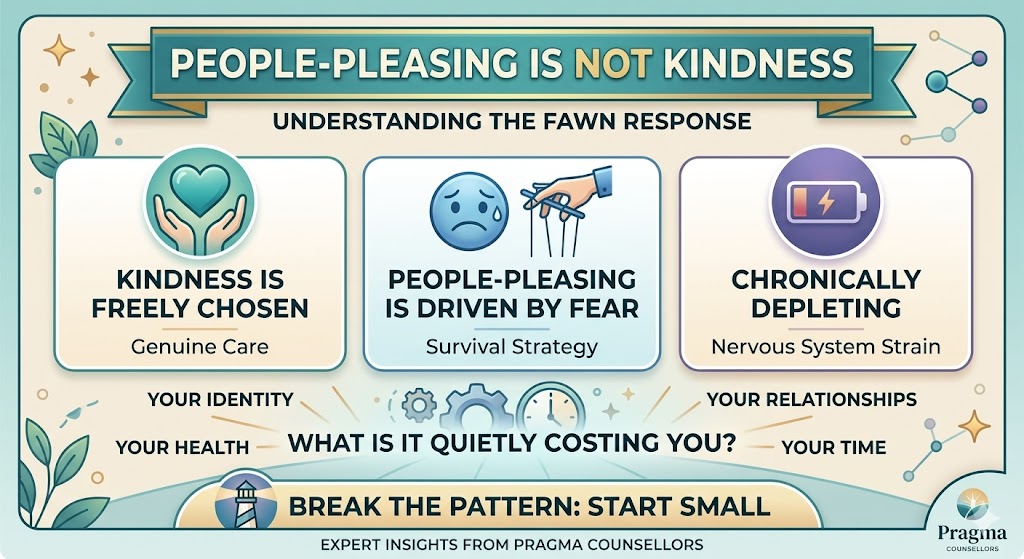
Table of Contents
- What People-Pleasing Actually Is — Beyond the Nice Person Label
- Where People-Pleasing Comes From — The Root You Probably Haven’t Considered
- 8 Signs You Are a People-Pleaser (Even If You Don’t Think You Are)
- What People-Pleasing Is Quietly Costing You
- The Real Talk: Why “Just Say No” Advice Is Completely Useless
- How to Actually Stop People-Pleasing — What Works in Real Life
- Books That Changed How My Clients See This Pattern
- FAQ
What People-Pleasing Actually Is, Beyond the Nice Person Label {#what-is}
Let me clear something up immediately because it matters enormously for how you approach this pattern.
People-pleasing is not kindness. Kindness comes from genuine care and is given freely. People-pleasing comes from fear and is given compulsively whether you want to give it or not, whether you have it to give or not, whether the other person deserves it or not.
The clinical term used in psychology is fawn response first described by therapist Pete Walker as a trauma response that sits alongside fight, flight, and freeze. When a person learned early in life that their safety, love, or acceptance depended on keeping others happy, the nervous system developed fawning as a survival strategy. Please the person. Manage their mood. Become whatever they need you to be. Stay safe.
The problem is that a survival strategy developed for a childhood environment does not automatically switch off when you enter adulthood. The fawn response that protected you as a child follows you into your adult relationships, your workplace, your friendships, and your marriage firing in situations where your physical safety is not actually at risk, but where your nervous system perceives social rejection as equivalent to danger.
So when I say people-pleasing is not about being nice, I mean it literally. It is a fear response. It is anxiety management. It is your nervous system trying to control an outcome by making yourself indispensable, inoffensive, and endlessly accommodating.
And the cost of running that programme every single day in every relationship, every interaction, every decision is enormous.
If you have been in a toxic relationship or an emotionally abusive dynamic, people-pleasing is almost certainly a feature of how that relationship functioned and may well have been a pattern long before the relationship began.

Where People-Pleasing Comes From — The Root You Probably Haven’t Considered {#roots}
Most people assume people-pleasing is just their personality. They say “I’m just naturally a giver” or “I’ve always been like this.” And they are partially right but the reason they have always been like this is almost never personality. It is history.
People-pleasing almost always develops in childhood, in environments where a child’s emotional needs were conditional. Conditional on their behaviour. Conditional on their performance. Conditional on how they managed the moods of the adults around them.
This might look like a parent who was warm and loving when the child behaved perfectly and cold or critical when they did not. It might look like a chaotic or unpredictable home where managing a parent’s emotional state became the child’s primary job. It might look like a family where conflict was terrifying and harmony was maintained at all costs and the child learned, very early, that their job was to be the peacemaker.
I worked with a client I will call her Emma who was the eldest of four children in a home where her father’s moods were volatile and unpredictable. From the age of seven, she had learned to read the emotional temperature of every room she walked into before she even decided how to exist in it. She had become extraordinarily skilled at managing other people’s feelings. By her mid-thirties she was doing it constantly at work, in her marriage, with her friends and she was completely burnt out. She had no idea what she actually wanted from her own life because she had spent thirty years focused entirely on what everyone else needed.
Here is the painful truth that Emma eventually had to sit with: nobody taught her to people-please to be cruel. Her environment simply taught her that her needs mattered less than keeping the peace. That lesson was absorbed at an age before she had any capacity to question it. And it ran her life for three decades.
This connects directly to what I see in clients who have experienced childhood trauma the people-pleasing pattern is often one of the most enduring legacies of growing up in an environment where safety was conditional on performance.
8 Signs You Are a People-Pleaser (Even If You Don’t Think You Are) {#signs}
1. You Apologise Constantly For Things That Are Not Your Fault
You apologise when someone walks into you. You apologise for having an opinion. You apologise for taking up time when you are the one who was asked for help. You apologise for being ill. You apologise for existing in ways that might conceivably inconvenience another human being.
This compulsive apologising is not politeness. It is a pre-emptive defence against imagined criticism a way of constantly signalling that you are aware of your potential inadequacy and are already sorry about it. In my practice I ask clients to track how many times they apologise in a single day. The results are almost always shocking to them.

2. You Find It Physically Painful to Disappoint People
Not uncomfortable. Painful. The anticipation of someone being unhappy with you produces a physical response tightening in the chest, a sick feeling in the stomach, a spike of anxiety that is completely disproportionate to the actual situation.
This is the fawn response I described above making itself known physically. Your body is treating social disappointment as a threat signal because at some point in your history, it was.
3. You Have No Idea What You Actually Want
When someone asks where you want to eat, you genuinely do not know. Not because you are indecisive because you have spent so long focusing on what other people want that your own preferences have gone quiet from disuse.
I find this sign particularly heartbreaking because it is often the last thing people recognise in themselves. They come to therapy for anxiety, for burnout, for relationship problems and eventually we arrive at the discovery that they cannot answer the simplest questions about their own desires, opinions, or needs. They have been edited out of their own lives.
4. You Say Yes and Then Secretly Resent It

You agree to things and then spend the entire time leading up to them wishing you had not. You do the thing help move the furniture, attend the event, stay late at work while feeling quietly furious about it. But you keep that fury entirely to yourself. And then the next time someone asks, you say yes again.
This cycle of compulsive yes, followed by private resentment, followed by compulsive yes again, is one of the most exhausting patterns in human psychology. The resentment cannot go anywhere because expressing it would require admitting you did not want to do the thing which would require accepting that you have needs and limits which your nervous system has categorised as dangerous.
5. You Change Your Opinions Based on Who You Are Talking To
You agree with your conservative colleague at work and your progressive friend at dinner. You support your sister’s decision in conversation with her and express doubts about it in conversation with your mother. You mould your perspective to the shape of whoever you are with.
This is not diplomacy. It is identity instability driven by a constant need for approval. The terrifying thing about this sign is that people who do it for long enough lose track of what they actually believe. Their own perspective becomes genuinely inaccessible to them.
6. You Take Responsibility for How Other People Feel
When someone is unhappy, you assume it is your fault and your job to fix it. When there is conflict in the room, your body mobilises to resolve it even when the conflict has nothing to do with you. When someone is in a bad mood, you take it personally and immediately begin the work of figuring out what you did.
This pattern is called hyper-responsibility for others’ emotions and it is extraordinarily draining. You are essentially running an emotional customer service department for every person in your life, twenty-four hours a day, with no days off and no pay.
7. You Cannot Receive Help, Compliments, or Care Gracefully
This one surprises people. People-pleasers are often very uncomfortable receiving. They deflect compliments. They refuse help even when they desperately need it. They minimise their own struggles to avoid burdening others.
The inability to receive is the flip side of compulsive giving. If your worth in relationships is based entirely on what you provide to others, then needing something yourself feels like a transaction you have no right to make.
8. You Feel Responsible for Managing Everyone’s Comfort Except Your Own
At the dinner party, you are tracking whether every guest has a drink, whether the conversation feels comfortable, whether anyone looks left out while your own experience of the evening goes entirely unmonitored. At work, you are managing the team’s morale, the boss’s expectations, and the client’s feelings while your own limits go entirely unacknowledged.
You are extraordinarily attuned to other people and almost completely blind to yourself.

What People-Pleasing Is Quietly Costing You {#costs}
This is the section most people-pleasers have never fully sat with. Because the cost is not dramatic. It does not arrive all at once. It accumulates slowly, quietly, over years until one day you look up and realise how much has gone.
Your identity. When you spend years being what everyone else needs, you lose track of who you actually are. Your tastes, preferences, opinions, and desires have been subordinated so consistently that they have genuinely faded. Rebuilding an identity in your thirties or forties after a lifetime of people-pleasing is one of the hardest pieces of therapeutic work I do with clients.
Your relationships. Here is the painful paradox: people-pleasing does not make relationships better. It makes them hollow. People who only ever agree with you, only ever accommodate you, only ever tell you what you want to hear they are not real to you. You cannot truly connect with someone who has no edges, no limits, no genuine self. People-pleasers are often surrounded by people and profoundly lonely.
Your health. Chronic people-pleasing is chronic stress. The relentless suppression of your own needs and the constant management of others’ emotions keeps your nervous system in a permanent low-grade stress response. Research links chronic emotional suppression to elevated cortisol, compromised immune function, and significantly higher rates of anxiety and depression. The nighttime anxiety that keeps so many of my clients awake is often rooted directly in the accumulation of unprocessed feelings from a day spent managing everyone else.
Your time. Every yes you did not mean is time spent on someone else’s priorities instead of your own. People-pleasers are chronically overcommitted, chronically behind on the things that matter to them, and chronically exhausted by a schedule that was never really theirs.
Your self-respect. Every time you say yes when you mean no, you send yourself a message: my needs do not matter enough to protect. Repeated thousands of times over years, that message becomes a belief. And that belief shapes every subsequent relationship, every subsequent decision, every subsequent version of you.
The Real Talk: Why “Just Say No” Advice Is Completely Useless {#real-talk}
I want to be direct about something because I think most articles on people-pleasing fail their readers here.
Telling a people-pleaser to “just say no” is approximately as useful as telling someone with a phobia of heights to “just look down.” The intellectual instruction is not the problem. The nervous system is the problem. And the nervous system does not respond to instructions.
People-pleasing is a trauma response that is maintained by very real fear. The fear of rejection. The fear of conflict. The fear of being seen as selfish, difficult, or unlovable. These fears are not irrational they were rational in the environment where they developed. They are just misfiring now.
You cannot think your way out of a fear response. You can only gradually retrain your nervous system through repeated experiences of saying no, tolerating the discomfort, and discovering that the catastrophe you were bracing for did not arrive.
That process is slow. It is uncomfortable. And it is genuinely impossible to do entirely alone which is why I am deeply skeptical of any article, course, or self-help book that promises to fix people-pleasing in a weekend. The pattern took years to develop. It takes sustained, consistent work to change.
I also want to name something about the self-help industry that I find genuinely problematic: many people-pleasing resources are written in a way that is itself people-pleasing they are so careful not to challenge the reader, so focused on validating everything, that they never actually confront the work that needs to be done. I find that a disservice to the people who need real help.
How to Actually Stop People-Pleasing — What Works in Real Life {#stop}
1. Learn to Tolerate the Discomfort of Saying No — Not Eliminate It
The goal is not to feel comfortable saying no. The goal is to say no while feeling uncomfortable and to discover, repeatedly, that you survive it. Discomfort tolerance is a skill that is built through practice, not through motivation. Start small. Say no to something low-stakes. Notice what happens in your body. Notice that the relationship did not end. Notice that you are still okay. Build from there.
2. Buy Time Instead of Saying Yes Automatically
The automatic yes happens because people pleasers make decisions from fear in real time. Slow the process down. “Let me check my schedule and get back to you.” “I need to think about that I’ll let you know tomorrow.” This single habit breaks the automaticity of the pattern and gives you space to make a decision from your actual wants rather than your anxiety.
I tell clients this is the first practical step and it works quickly. You are not saying no yet. You are just pausing long enough to ask yourself: do I actually want to do this?
3. Distinguish Between Guilt and Shame
When you say no to something, the uncomfortable feeling that follows is usually guilt and guilt, managed correctly, can be useful information. It tells you when you have actually done something wrong.
But most people-pleasers are not feeling guilt. They are feeling shame the feeling that they are wrong, fundamentally, for having limits at all. Guilt says “I did a bad thing.” Shame says “I am a bad person.” Learning to distinguish between those two responses is crucial because the interventions for each are completely different.
4. Understand That “No” Is a Complete Sentence
You do not owe anyone an explanation for your limits. A no that comes with twenty sentences of justification is still a no but it is a no that is asking for the other person’s approval of your no. That is still people-pleasing.
Practise saying no with a brief explanation and then stopping. “I can’t make it that evening thank you for thinking of me.” Full stop. No apologies, no elaborate justification, no guarantee that you would under different circumstances absolutely definitely say yes.
5. Get Support — This Is Therapeutic Work
I am a counselling psychologist saying this plainly: people-pleasing that is rooted in childhood trauma, attachment wounds, or prolonged emotional abuse requires more than self-help books and willpower. It requires sustained therapeutic work with a qualified professional who can help you trace the pattern to its roots and rebuild a relationship with yourself from the ground up.
If you recognise yourself deeply in this article if you have been living this pattern for years and it has cost you in the ways I described please do not try to manage this alone.
Bonus: Do One Thing This Week Purely for Yourself
Not for anyone else. Not because it will make you more productive or a better partner or a more effective professional. Just because you want to. Eat the food you want. Watch the thing you want. Take the walk you want. Go to bed when you want.
It will feel uncomfortable. Do it anyway. Your nervous system needs evidence that your own desires are allowed to exist.
Books That Changed How My Clients See This Pattern {#books}
Every one of these has spent time in my waiting room.
- 📖 Set Boundaries Find Peace by Nedra Tawwab — the clearest, most practical guide to boundaries I have ever read. Nedra Tawwab writes with warmth and zero judgment. My top recommendation for anyone starting this work. The Amazon reviews alone tell you how many lives this book has changed.
- 📖 The Disease to Please by Harriet Braiker — specifically written for the people-pleasing pattern. Older but still one of the most comprehensive books on the subject. Excellent on the cognitive patterns that maintain the behaviour.
- 📖 Not Nice by Dr Aziz Gazipura — a more confrontational read than most on this topic, which is exactly why I recommend it. Gazipura does not let the reader stay comfortable. He challenges the story that niceness and people-pleasing are the same thing. Important.
- 📖 Adult Children of Emotionally Immature Parents by Lindsay Gibson — for people-pleasers whose pattern started with a difficult parent. One of the most important books in my library. Gibson’s work helped more clients understand the roots of their behaviour than almost anything else I have recommended.
- 📓 The Boundary Boss Workbook by Terri Cole — a practical companion workbook for anyone who processes better through writing and exercises than through reading alone. Structured, warm, and genuinely useful.
These are Amazon affiliate links. Pragma Counsellors may earn a small commission if you purchase through them at no extra cost to you. I only recommend books I give to my own clients.
Frequently Asked Questions {#faq}
Q: Is people-pleasing the same as being kind? No and this distinction matters enormously. Kindness is freely chosen, comes from genuine care, and does not deplete you when you give it. People-pleasing is compulsive, driven by fear of consequences, and is chronically depleting. You can tell the difference by checking in with yourself afterwards: did that feel nourishing, or did it feel like a tax you had no choice but to pay?
Q: Can people-pleasing cause anxiety and depression? Yes and the research is clear on this. Chronic emotional suppression, chronic over-commitment, and the constant disconnection from your own needs all contribute significantly to anxiety and depression. Many clients come to me with anxiety or depression as the presenting issue, and we find people-pleasing as a central maintaining factor. Treating the anxiety without addressing the people-pleasing produces limited results.
Q: Is it possible to be a people-pleaser without knowing it? Completely. Many people-pleasers describe themselves as “just a helpful person” or “someone who likes to keep the peace.” The pattern is often invisible to the person living it because it has been normalised over a lifetime. The signs in this article particularly the resentment, the identity loss, and the discomfort with saying no are often the first cracks of recognition.
Q: How long does it take to stop people-pleasing? This is not a pattern that shifts in weeks. Changing a deeply ingrained trauma response takes months of consistent work in therapy, in daily practice, in relationship. Most clients who commit seriously to this work see meaningful shifts within 3–6 months, and deeper transformation over 12–18 months. I want to be honest about that timeline because I think it serves people better than promising a quick fix.
Q: Can people-pleasing affect my physical health? Yes. The chronic stress of emotional suppression has documented physical effects elevated cortisol, disrupted sleep, compromised immune function, and increased risk of burnout. I have worked with clients whose physical health improved measurably after they began setting limits and reducing their people-pleasing behaviour. The body keeps the score on this pattern just as much as any other form of chronic stress.
Parting Wisdom
That period in my late twenties when I had effectively disappeared as a person it ended the day I cancelled something I had agreed to do and the world did not end.
I had agreed to attend a work event I deeply did not want to attend. I had said yes automatically, immediately, without checking whether I actually wanted to go. Then I spent three weeks dreading it.
The day before, I sent an apology and said I could not make it. I spent the evening waiting for the fallout. There was none. The person replied within ten minutes: “No worries at all hope you’re okay.”
No worries at all.
I had been paying a tax on my life my time, my energy, my identity for years. And the thing I had been so afraid of was nothing. It was the story in my head that had been the jailer all along.
Your needs are not a burden. Your limits are not selfishness. And the people who leave because you started saying no were never really there for you in the first place.
My question for you: What is the one thing you have been saying yes to for months or years that you desperately want to say no to? You do not have to name the person or the situation. Just the feeling it gives you when you think about it.
Drop it in the comments below. I read every single one and I respond personally. You might be surprised how much lighter it feels just to write it down.
Ready to do this work with support? At Pragma Counsellors we work with clients navigating people-pleasing, anxiety, boundary-setting, and relationship patterns in a space that is confidential, non-judgmental, and genuinely focused on you.
We offer a free 15-minute consultation no commitment, no pressure. Online sessions available for clients in the US, UK, and internationally.
📍 Muhoho Avenue, South C, Nairobi, Kenya 📞 +254 752 448 315 / +254 784 684 422 📧 contact@pragmacounsellors.com 🌐 Online sessions available globally 👉 Book your free consultation here
