

By a Counselling Psychologist / Pragma Counsellors, Nairobi
How to Deal With Grief and Loss in Kenya! My client , I’ll call her Vale, lost her mother on a Tuesday. By Friday, the house was full of relatives. Food was being cooked in the compound. A pastor had come. Songs were being sung. Everyone was busy doing something.
By the following Tuesday, everyone had gone home.
And Vale sat alone in her living room, completely unable to move, unable to eat, unable to explain to anyone why she was still falling apart, because she had been told, repeatedly, in the kindest possible way, that her mother was “now with God” and that she needed to “be strong for the children.”
Nobody had asked her how she was actually feeling. Nobody had told her that what comes after the funeral can be the hardest part. And nobody had warned her that grief in Kenya does not always look the way the church tells you it will.
This article is for Vale. And for everyone who has sat in that empty living room and wondered if something was wrong with them.
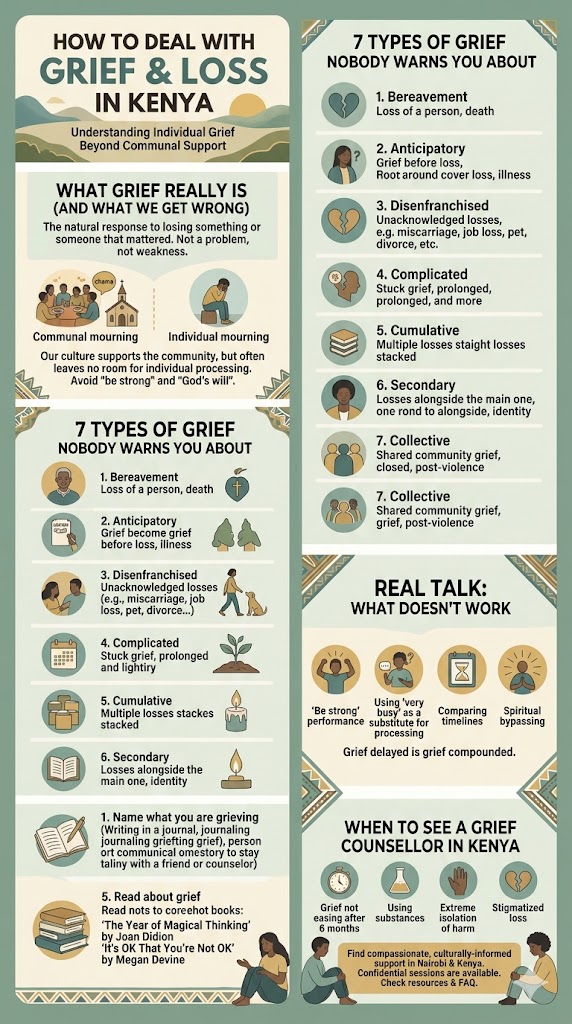
Table of Contents
- What Grief Really Is — And What Our Culture Gets Wrong About It
- The 7 Types of Grief Nobody Warns You About
- Signs Your Grief Has Become Something More Serious
- What Kenyan Culture Gets Right — and Where It Falls Short
- 5 Practical Ways to Deal With Grief and Loss in Kenya
- The Real Talk: What Doesn’t Work
- Books and Resources That Actually Help
- When to See a Grief Counsellor
- FAQ
What Grief Really Is — And What Our Culture Gets Wrong About It {#what-grief-is}
Grief is the natural response to losing something or someone that mattered to you. That’s it. It is not a problem. It is not weakness. It is not a lack of faith. It is what love looks like after loss.
But here is what our Kenyan communities rarely say out loud: grief is individual. Research from Oxford Academic studying bereavement among the Luo, Luhya, and Embu communities found that while our cultural practices do an excellent job of supporting communal mourning, they leave almost no room for individual mourning. The harambee comes. The chama brings food. The church prays. And then everyone goes back to their lives , often before the bereaved person has even begun to process what happened.
I have sat with clients who lost a spouse and were told to “move on” within three months. Others who lost a child and were told it was “God’s will” the moment they started crying. Others still who lost a job, a marriage, or a pregnancy and were told those things don’t even qualify as real grief.
All of that is wrong. And it is costing people their mental health in ways they don’t recognise until years later.
The 7 Types of Grief Nobody Warns You About {#types-of-grief}
Most people think grief only happens when someone dies. That is a very limited view of a very human experience.
1. Bereavement grief — the loss of a person through death. This is the most recognised form in Kenya, but even here, the complexity is underestimated. Sudden deaths, deaths from illness, and deaths involving stigmatised conditions like HIV/AIDS or suicide each carry their own weight.
2. Anticipatory grief — the grief you feel before the loss. If you have a parent with cancer, a child with a serious diagnosis, or a marriage that is visibly dying, you may already be grieving. This is real grief and it is exhausting.
3. Disenfranchised grief — grief that your community does not fully acknowledge. Losing a pregnancy. Losing a job. Losing a pet. Going through divorce. Experiencing a close friendship end. These losses are real. The pain is real. The fact that nobody brings you food does not mean you are not grieving.
4. Complicated grief (Prolonged Grief Disorder) — grief that does not ease over time and begins to take over your functioning. Research from Cambridge University that included 619 Kenyan participants found that “feelings of loss” and “difficulty moving on” were the most central symptoms. This is not normal grief. It is a clinical condition that responds well to treatment.
5. Cumulative grief — when losses stack on top of each other before you have had time to process any of them. In Kenya, where many people experience the death of multiple family members in a short period, this is far more common than we admit.
6. Secondary grief — grieving all the things that disappear alongside the main loss. When your husband dies, you also grieve your identity as a wife, your financial security, your plans for the future, and your sense of safety. These secondary losses are often never spoken about.
7. Collective grief — grief shared by a whole community. After the post-election violence of 2007–2008, after Westgate, after COVID. Many Kenyans are still carrying collective grief that was never formally processed.

Signs Your Grief Has Become Something More Serious {#complicated-grief}
Normal grief is painful. But it generally moves, it shifts, it changes shape, it gradually allows small moments of relief. Complicated grief (clinically known as Prolonged Grief Disorder, now in both ICD-11 and DSM-5-TR) is different. It gets stuck.
Watch for these signs in yourself or someone you love:
- Intense longing for the person lost that does not ease after six months or more
- Difficulty accepting that the loss happened , even when you know it intellectually
- Bitterness or anger that feels disproportionate and constant
- Feeling that life is meaningless without the person who died
- Complete withdrawal from people, activities, or responsibilities
- Physical symptoms, persistent fatigue, chest tightness, sleep problems, appetite changes with no clear medical cause
- Thoughts of wanting to die, or of joining the person who died
Research involving Kenyan bereavement survivors found that seeking help from mental health professionals is often delayed or avoided entirely because of stigma with some people fearing they would be “labelled as crazy” or seen as an outsider for naming their grief as a mental health problem.
That stigma is costing lives. If you recognise yourself in this list, please read the section on professional help below.
What Kenyan Culture Gets Right — and Where It Falls Short {#culture}
I want to be honest here, because I think both extremes dismissing our culture and idealising it miss the point.
What our culture gets right
The communal nature of Kenyan mourning is genuinely therapeutic. Research on Luhya mourning rituals published in Oxford Academic in 2025 found that traditional rituals played an important role in community wellbeing and that bereaved individuals who participated in both cultural and religious rituals reported better grief processing than those who did not. When the community shows up literally, physically shows up, it signals that you are not alone. That matters enormously.
The role of prayer, song, and shared storytelling about the deceased also serves real psychological functions. Narrating the life of someone who has died helps the bereaved construct meaning from their loss. It is, in its own way, a form of grief therapy.
Where our culture falls short
The problem comes when communal support is mistaken for a substitute for individual processing. Our rituals are built for the group. They are not always built for the individual who cannot sleep at 3am three months after the funeral.
We also struggle enormously with grief that does not fit our expected timeline. A Kenyan who is visibly still grieving six months after losing a spouse risks being told they are “wallowing,” that they need to “be strong,” or in some communities, that something spiritual is wrong with them. This pressure to perform recovery before it has actually happened is one of the most psychologically damaging things I see in my practice.
And our culture provides almost no language for disenfranchised grief. If you lose a pregnancy early enough that few people knew about it, you may grieve entirely alone. I’ve found that this specific silence causes some of the deepest and most lasting wounds I encounter.

5 Practical Ways to Deal With Grief and Loss in Kenya {#how-to-cope}
These are the strategies I share with clients. They are not glamorous. They are not instant. But they work.
1. Name what you are grieving (all of it)
Most people grieve the headline loss. The person. The job. The relationship. But grief is almost always layered. Sit down with a journal and write out every single thing you have lost alongside the main loss. The routines. The future you planned. The identity you held. The financial security. The person who understood you.
Naming all of it does not make it worse. It makes it processable. Grief you cannot name is grief that controls you from the inside.
Try this: Get a good journal, I personally recommend the Leuchtturm1917 Hardcover Notebook (Amazon link) for journaling grief and spend 15 minutes each morning writing without stopping. Do not edit. Just write.
2. Allow your body to grieve, not just your mind
Grief is not only a psychological experience. It lives in the body. Research consistently links bereavement to physical symptoms , chest tightness, fatigue, appetite disruption, immune suppression. Ignoring these physical signals does not make them go away.
Walk. Swim. Sleep. Eat real food even when it has no taste. Go for early morning walks along Karura Forest if you are in Nairobi. The body needs gentle, regular movement to metabolise the stress hormones that grief floods into your system. This is not optional self-care. It is biological necessity.
3. Find one person who will let you tell the story again
Grief counselling research consistently shows that being able to narrate your loss to tell the story of what happened, and what the person meant to you, repeatedly, is one of the most powerful healing mechanisms available. The problem is that most people in your life will stop being able to hear the story after the first month.
Find one person, a trusted friend, a sibling, a counsellor, who will let you keep telling it. If you cannot find that person in your network, that is exactly what a grief counsellor is for.
4. Create a personal ritual
Our communal rituals end. Your grief does not end on the same schedule. So create your own.
Visit the grave on the anniversary. Cook the deceased’s favourite meal on their birthday. Light a candle on the day they died. Plant something in their name. Write them a letter on difficult days. Research shows that personal mourning rituals, ones you design yourself, help the bereaved maintain a continuing bond with the person they have lost, which is a legitimate and healthy part of grief processing.
This is not “not moving on.” This is honouring a relationship that was real.
5. Read about grief — it helps to understand what you are going through
I am opinionated about this: The Year of Magical Thinking by Joan Didion is still the most honest account of grief I have ever read. Find it on Amazon here. It will not fix anything, but it will make you feel profoundly less alone.
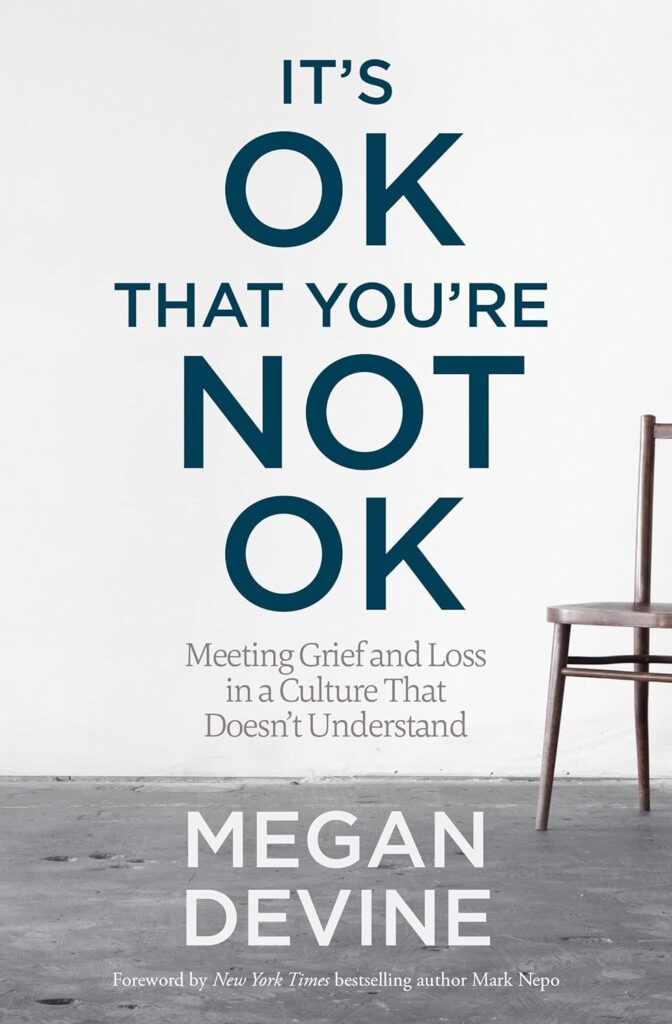
For something more structured and practical, It’s OK That You’re Not OK by Megan Devine is my top recommendation for clients who want to understand the grief process without being rushed through it. Amazon link here. Devine’s central argument , that grief is not a problem to solve but an experience to be witnessed — is the most important thing I wish more Kenyans were told after a loss.
Quick side note on apps: The free Wysa app (available on Android and iOS) offers grief-specific emotional support exercises between counselling sessions. I recommend it to clients as a between-session tool, not a replacement for actual counselling, but it is genuinely useful.
The Real Talk: What Doesn’t Work {#real-talk}

After five years of sitting with grieving people, here is my honest assessment of what does more harm than good.
“Be strong” as a grief strategy. I understand why we say it. Strength is a Kenyan value. But telling a grieving person to “be strong” is telling them that their grief is a performance problem to be corrected — not a human response to be supported. It drives the grief underground, where it does far more damage over time. I’ve worked with clients in their 40s still processing losses from their 20s because they were told to “be strong” and never actually grieved.
Using very busy as a substitute for processing. I call this the Kenyan grief workaround. Throw yourself into work. Fill every hour. Keep going, keep moving, keep doing. It works, until it doesn’t. And when it stops working, it stops dramatically. The grief that was never processed surfaces as anxiety, depression, physical illness, or an inexplicable collapse at what seems like the wrong moment. Grief delayed is not grief avoided. It is grief compounded.
Comparing timelines. “My mother died and I was fine after two weeks” is not a useful contribution to anyone’s grief process. Grief has no standard timeline. The ICD-11 guidelines flag prolonged grief only after 12 months following the loss of a spouse or child. Pressuring someone to be “over it” in weeks is not support. It is harm disguised as encouragement.
Spiritual bypassing. I am a person of faith. I work with many clients who are too. But telling a grieving person that “everything happens for a reason” or that they should “just trust God” before they have had space to actually feel their loss is using theology as an emotional shortcut. Faith and grief can coexist. You can believe your loved one is at peace and still be devastated. Both things are true. A faith community that makes room for both is a healthy one.
Books and Resources That Actually Help {#resources}
Here are my personal recommendations — things I refer clients to regularly:
- 📖 The Year of Magical Thinking — Joan Didion — the most honest grief memoir I have read
- 📖 It’s OK That You’re Not OK — Megan Devine — practical, non-preachy, deeply validating
- 📖 Grief Is the Thing with Feathers — Max Porter — for those who process through literature and metaphor
- 📓 Leuchtturm1917 Notebook for grief journaling — the best journal I have found for daily grief writing

Note: These are Amazon affiliate links. If you purchase through them, Pragma Counsellors may earn a small commission at no extra cost to you. I only recommend things I would give to my own clients.
When to See a Grief Counsellor in Kenya {#professional-help}
I’ll be direct: most people wait too long. They come to me after 18 months of not sleeping, or after a breakdown at work, or after their doctor has run every test imaginable and found nothing physically wrong. By that point, we are doing recovery work that could have been prevention work.
See a grief counsellor if:
- Your grief is not easing after six months and is interfering with your daily life
- You are using alcohol, substances, or compulsive behaviours to manage your feelings
- You are having thoughts of harming yourself or not wanting to be alive
- You feel completely unable to talk to anyone in your life about what you are going through
- Your grief is related to a stigmatised loss, suicide, pregnancy loss, divorce and you feel isolated in it
- You are supporting a grieving child and are not sure how to help them
At Pragma Counsellors in Nairobi, grief counselling is one of our core specialisations. We work with individuals, families, and couples navigating loss, including losses that others may not take seriously. Our sessions are confidential, culturally informed, and grounded in evidence-based approaches.
We offer a free 15-minute consultation. There is no commitment. Just a conversation. You deserve that much.
📍 Muhoho Avenue, South C, Nairobi 📞 +254 752 448 315/0784684422 👉 Book your free consultation here
Frequently Asked Questions {#faq}
Q: How long should grief last? There is no universal answer. For most people, the sharpest acute grief eases within 6–12 months, though waves of sadness can return for years, especially around anniversaries and milestones. If your grief is not easing at all after six months and is affecting your ability to function, that is worth discussing with a professional.
Q: Is it normal to feel angry after someone dies? Completely normal. Anger is one of the most common and least discussed grief emotions, especially in Kenya, where expressing anger in grief can be seen as disrespectful. You may feel angry at the person who died, at God, at the doctors, at the people who you feel didn’t do enough. This anger is not a character flaw. It is grief.
Q: Can you grieve a relationship that didn’t end in death? Yes. Divorce, a friendship ending, estrangement from a parent, a miscarriage, all of these are legitimate grief experiences. The fact that there is no funeral does not mean the loss is not real. Disenfranchised grief (grief your community doesn’t formally acknowledge) is extremely common and often goes completely unaddressed.
Q: Is grief counselling available and affordable in Kenya? Yes. Several qualified counsellors in Nairobi and other major towns offer grief-specific support. At Pragma Counsellors, we offer a sliding-scale arrangement for clients who need it. Access is improving. The first step is making contact.
Q: How do I help a grieving friend or family member? Show up physically if you can. Bring food. Sit with them. You do not need to have the right words, in fact, the pressure to find the right words is what stops most people from showing up at all. “I don’t know what to say, but I am here” is enough. It is more than enough.
Parting Wisdom for How to Deal With Grief and Loss in Kenya
Grief is not something you get over. It is something you learn to carry, and over time, with the right support, the weight becomes more manageable. The shape of it changes. There are more good days between the hard ones.
But that process takes time, space, and honesty, three things Kenyan culture sometimes struggles to give to individuals who are grieving.
“You are not weak for still being sad. You are not faithless for being in pain. You are not broken for needing help. You are a human being who loved someone or something, and then lost them.“
That deserves to be taken seriously.
My question for you: What has been the hardest part of grief that nobody prepared you for? What did someone do or not do that made a real difference?
Share your experience in the comments below. Your story might be exactly what someone else needs to be read today.
I read every comment personally and will respond where I can.
