
There is a common belief, one that echoes loudly in our busy lives here in Nairobi and beyond, that therapy is a tool reserved strictly for those who are at their absolute lowest point. signs you need therapy ; We tend to view counselling as an ambulance, something you call only after the accident has already happened. We think of it as a place for “serious” crises, deep trauma, or significant mental health disorders.
But the truth is much quieter, and much more profound. You don’t have to be “broken” to seek help. You don’t need to be in the middle of a catastrophe to justify walking through our doors.
You might look perfectly composed on the outside ,you go to work, you meet your deadlines, you take care of your family, and you show up for your friends. But on the inside, there is a persistent, nagging feeling of being overwhelmed, stuck, or emotionally drained. You might be sleeping, but you aren’t resting. You might be laughing, but you aren’t feeling joyful. This often leads to the internal question: “Do I really need therapy, or am I just being dramatic? Am I just tired?”
The answer, often, is that you deserve support simply because you are human. Therapy isn’t just about fixing what is broken; it is about understanding how you are wired, improving your mental well-being, and building a life that feels as good on the inside as it looks on the outside.
What Is Therapy, Really?
At its core, therapy, or counselling, is not an interrogation. It is not a place where you go to be diagnosed, judged, or told how to live your life. Think of it instead as a safe, confidential sanctuary. It is one of the few places in your week where the focus is entirely on you. You don’t have to be a boss, a parent, a partner, or a provider. You can simply be yourself.
When you sit down with a professional, like Peterson or Wendy here at Pragma, you are entering a partnership. We aren’t here to give you a checklist of “fixes.” We are here to listen to the tangled threads of your thoughts and help you gently straighten them out.
Why People Choose Therapy
- The Desire for Clarity: Sometimes life feels like a fog. You know something is off, but you can’t quite name it. Therapy provides the lens to see clearly.
- Skill Building: Life didn’t come with a manual. Therapy provides the coping mechanisms for when you face conflict, loss, or transition.
- Emotional Regulation: If you find yourself overreacting to small things or feeling “numb” to big things, therapy helps you find your middle ground.
- Deep Connection: When you understand your own patterns, your relationships with others naturally improve. You stop projecting your past onto your present.

The Subtle Signs You Need Therapy
You don’t need a flashing neon sign to tell you it’s time to talk. Often, the signals are subtle, persistent, and quiet. They are the background noise of your daily life.
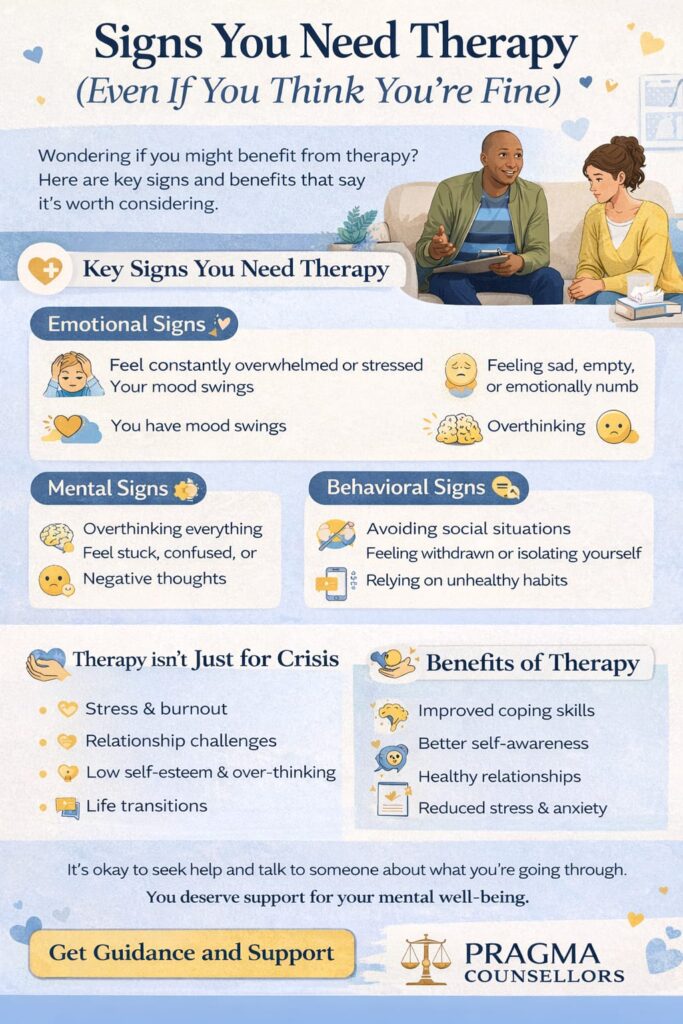
1. Emotional Signs: The Weight You Carry
Do you find yourself feeling constantly “on edge”? It’s one thing to have a stressful day; it’s another to live in a state of chronic stress. If you experience frequent mood swings, where you feel fine one moment and irritable or hopeless the next, that is your emotional system telling you it’s over-taxed.
Many people also struggle with a sense of “emotional numbness.” You know you should be excited about a promotion or happy at a family gathering, but you feel nothing. That emptiness is just as valid a reason to seek support as intense sadness.
2. Mental Signs: The “Overthinking” Trap
We live in an age of information overload. If you find your mind is a constant loop of “What if?” and “I should have…”, you are likely stuck in a cycle of analysis paralysis. When your thoughts become heavy, repetitive, or self-critical, they stop being productive and start becoming a burden.
If you find it difficult to focus, or if you are procrastinating on simple decisions because you are afraid of making the “wrong” choice, your brain is signaling that it needs a partner to help you sort through the noise.
3. Behavioral Signs: The Patterns We Create
Sometimes, we don’t feel the emotion; we act it out. Have you started withdrawing from friends? Are you saying “no” to social events that you used to love? Are you relying on “numbing” behaviors—like excessive screen time, late-night scrolling, or isolation—just to get through the evening?
These are not character flaws. They are coping mechanisms. They are your way of trying to protect yourself, but they often end up trapping you in a smaller, lonelier life.
The Myth of Being “Broken”
One of the most persistent barriers to mental wellness is the belief that therapy is only for people who are “broken” or “weak.” Let’s dismantle that right now.
Think of your physical health. You go to the gym to build strength, you eat well to prevent illness, and you visit a doctor for a check-up even if you aren’t in the ICU. Why should your mental health be any different?
Therapy is proactive maintenance. If you are a person who wants to grow, to improve your communication, to navigate a life transition like a new job, a relocation, or the end of a relationship, therapy is the most effective tool in your kit. Seeking help is an act of extreme courage. It takes more strength to sit in a chair and face your inner thoughts than it does to bury them and keep moving.
Friends vs. Therapists: Why Professional Support Matters
A common question we hear is: “I have friends I can talk to. Why do I need a therapist?”
Friends are incredible. They provide love, history, and shared experience. But there are three key reasons why a therapist is different:
- Neutrality: Your friends are biased. They want to protect you, which might mean they agree with you even when your perspective is skewed. A therapist is neutral. We aren’t here to take sides; we are here to help you navigate toward the truth.
- Confidentiality: Sometimes, you can’t tell your friends the whole truth because of the social complexity. You worry about judgment, gossip, or changing the dynamic. In the therapy room, what happens there stays there. You can be fully, brutally honest.
- Specialization: Friends offer opinions; therapists offer tools. We have spent years studying the human mind. We know how trauma manifests, how habits form, and how to gently guide you through the “stuck” points that talking over a cup of tea might not resolve.
What Happens in a Session?
If you are nervous about your first session, know that you are not alone. Most people feel a mix of apprehension and hope.
When you sit down with a professional like Peterson or Wendy, you are in a space designed for you. There is no script. You don’t have to “perform.”
- You set the pace: We start where you are comfortable.
- You are heard: We listen actively, without interrupting, to understand your narrative.
- We explore: We ask questions that help you connect the dots between your past experiences and your current feelings.
- We build tools: We don’t just talk about the problem; we identify strategies—like box breathing, boundary setting, or perspective-shifting—that you can use the moment you step out of the room.
When to Stop Waiting and Start Acting
There is a moment in everyone’s life where the “I’ll deal with it later” approach stops working.
Perhaps you realize that your anxiety is starting to affect your physical health—you’re getting frequent headaches, tension in your shoulders, or your sleep is erratic. Or maybe you notice that your relationship is suffering because you are too mentally exhausted to engage with your partner or children.
When your internal struggle begins to impact your daily performance, your relationships, or your sense of self-worth, that is the moment to reach out. You don’t have to reach “rock bottom” to deserve a helping hand.

Conclusion: You Deserve Support
You don’t have to wait until things get worse to seek therapy. If you feel overwhelmed, stuck, or unsure, talking to a professional can provide the clarity and relief you need. Recognizing the signs you need therapy—the subtle shifts in your mood, the persistent thoughts, the change in your behavior—is the first, courageous step toward a healthier and more balanced life.
Remember, the goal of therapy isn’t to change who you are. The goal is to strip away the anxiety, the overthinking, and the past hurts so that the real you can emerge. You deserve to feel lighter. You deserve to be heard.
Frequently Asked Questions (FAQs)
Q1: How do I know for sure if I need therapy? There is no “required” list of symptoms. If you feel like your life could be better, or if you feel consistently drained, that is reason enough. You don’t need a medical diagnosis to qualify for support.
Q2: Is therapy only for serious problems or big traumas? Absolutely not. While we certainly help with deep challenges, the majority of our clients come to us to navigate everyday life—work stress, relationship hurdles, personal growth, and self-esteem.
Q3: What if I feel “fine” but just curious about therapy? That is often the best time to start! Some of the most productive therapeutic work happens when you are in a relatively stable place, allowing you to build resilience before the next big storm hits.
Q4: How soon will I see results? It varies. Some people feel a sense of relief after just one session because they finally shared a burden they were carrying alone. For deeper shifts, it is a process, but you will find that even small steps make a difference in your daily outlook.
Q5: Is it affordable? Think of therapy as an investment in your most valuable asset: yourself. When you improve your mental health, you improve your ability to work, relate, and succeed. The “return” on that investment is a better quality of life.
Your journey toward clarity doesn’t have to be a lonely one. Whether you’ve been struggling for a while or you’re just starting to notice that things don’t feel quite right, Pragma Counsellors is here for you. You don’t have to figure everything out on your own.
