
We live in a world that never truly sleeps. From the moment the morning alarm on your smartphone nudges you awake to the final scroll through social media before you drift off, screens have become our constant, unblinking companions. But have you ever paused, closed your laptop, or locked your phone, and realized you feel… hollow? Exhausted?
You haven’t run a marathon. You haven’t lifted heavy weights. Yet, you feel a deep, pervasive fatigue that seems to settle behind your eyes.
This isn’t just “being tired.” This is digital burnout, and it is becoming one of the quietest, most pervasive mental health challenges of our generation. If you feel like your brain is constantly “on” but you are struggling to actually do anything, you aren’t failing, you’re just overloaded.
Introduction: Are You Experiencing Digital Burnout?
At Pragma Counsellors, we hear this story often. Clients come in describing a sense of being “wired and tired.” They feel an itch to check their notifications even when they’re in the middle of a beautiful dinner, a walk in the park, or a conversation with a loved one. They are physically present, but mentally, they are trapped in a digital loop.
Digital burnout isn’t a sign that you are addicted or weak. It is a biological reaction to an environment we were never designed to inhabit—one where our attention is constantly being harvested, pinged, and interrupted. Recognizing this fatigue is not an admission of defeat; it is the very first step toward reclaiming your sanity.
What Is Digital Burnout?
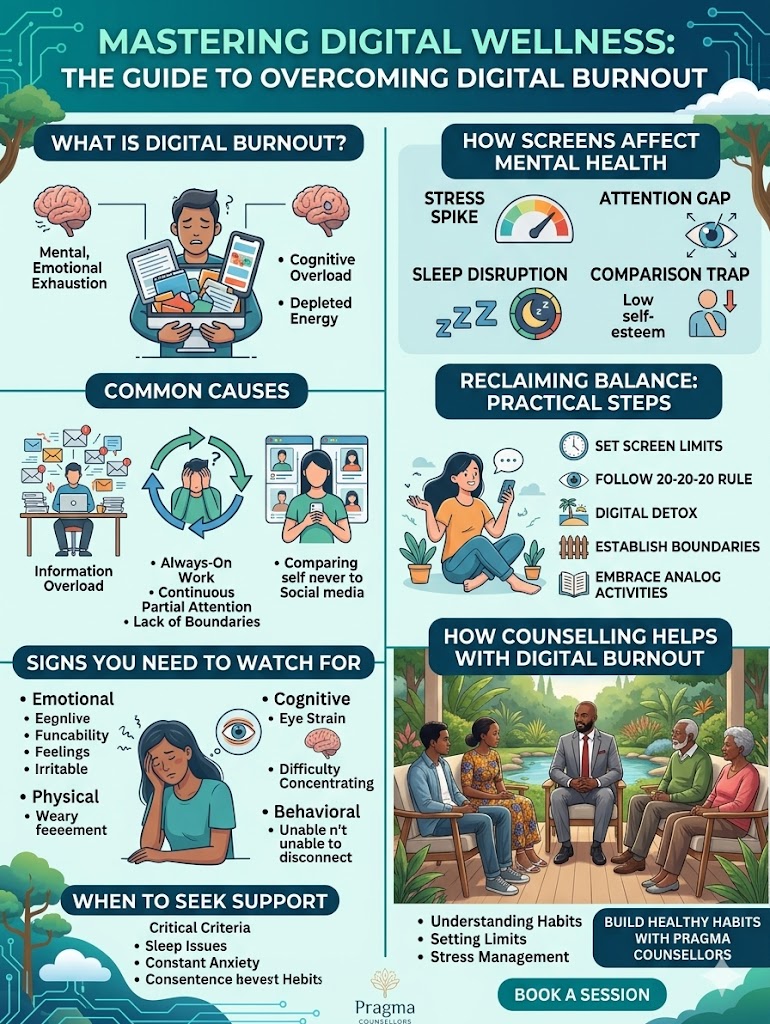
Digital burnout is a state of mental and emotional exhaustion caused by the prolonged and excessive use of digital devices. It goes beyond simple eye strain. It is a form of cognitive depletion where your brain’s ability to process, filter, and store information gets jammed.
Think of your brain like a computer with fifty tabs open. Eventually, the fan starts whirring, the system slows to a crawl, and programs start crashing. That is your brain on digital overload.
Common Drivers of Digital Burnout
- The “Always-On” Work Culture: The silent expectation that you should respond to emails within minutes, regardless of the time of day.
- The Infinite Scroll: Social media algorithms are designed to keep you engaged, triggering a dopamine loop that leaves you feeling drained once the novelty wears off.
- Continuous Partial Attention: Trying to work, text, and listen to a podcast simultaneously means your brain never enters a “deep work” or “rest” state.
- Lack of “White Space”: We no longer have moments of boredom, the moments where our brains naturally reset because we fill every gap with a screen.
Signs of Digital Burnout You Should Not Ignore
Because digital burnout is often silent, we tend to normalize the symptoms. We blame the coffee for our anxiety or the lack of exercise for our poor sleep. Check in with yourself are you experiencing these signs?
The “Hidden” Symptoms
- Emotional: You feel “numb” or irritable. You snap at people for no real reason, or you feel a sudden, sharp spike of anxiety when a notification sound pings.
- Cognitive: You are struggling to finish a single task. You start an email, check Instagram, look at a news headline, and forget what you were doing in the first place.
- Physical: You’re dealing with the “Tech Neck” (pain in the upper back), persistent headaches, or that “sand in the eyes” sensation that won’t go away.
- Behavioral: You find yourself “phantom vibrating” feeling your phone buzz in your pocket even when it’s not there.
How Screen Time Is Affecting Your Mental Health
When we talk about the impact of screens, we are really talking about the impact on your nervous system.
- The Stress Spike: Constant notifications keep your body in a low-level “fight or flight” mode. Your cortisol levels rise, and your body stays prepared for a threat that is usually just an annoying email.
- The Attention Gap: Our brains are losing the ability to sustain focus on long-form tasks (like reading a book or deep problem-solving) because we are training them to crave constant, rapid-fire input.
- The Comparison Trap: When your world is filtered through screens, you are constantly comparing your “behind-the-scenes” reality to everyone else’s “highlight reel,” which silently chips away at your self-worth.

What Is a Digital Detox and Do You Need One?
A digital detox isn’t about throwing your smartphone into the nearest river. It’s about creating intentional gaps in your digital life.
Ask yourself: Do you feel a momentary pang of panic if you leave your house without your phone? Do you check your emails the second you open your eyes? If you answered “yes,” a detox isn’t just a fun idea—it’s necessary for your emotional hygiene.
How to Reduce Digital Burnout: Practical Steps
You don’t have to go off the grid to be healthy. Try these small, actionable shifts:
- The “20-20-20” Rule: Every 20 minutes, look at something 20 feet away for 20 seconds. It forces your eyes and your brain to refocus on the physical world.
- Tech-Free Zones: Designate the bedroom as a screen-free zone. Buy a real alarm clock and leave the phone charging in another room.
- Audit Your Notifications: If an app isn’t essential for your immediate survival or work, turn off its alerts. Take back the power to choose when you check your messages.
- Analog Hobbies: Rediscover things that don’t have a power button. Reading, gardening, walking without headphones, or sketching. These activities allow your brain to enter a state of “default mode,” which is essential for mental recovery.

How Counselling Helps with Digital Burnout
Sometimes, the difficulty in unplugging comes from deeper issues, like a need for validation, an underlying fear of missing out, or the pressure to perform at work.
At Pragma Counsellors, we help you peel back the layers. We help you explore:
- Why you feel you “need” to be available 24/7.
- How to set healthy professional boundaries without the fear of being “unproductive.”
- How to reconnect with your own thoughts, desires, and calm.
When Should You Seek Help?
If you find that your relationship with technology is preventing you from sleeping, eating well, or maintaining healthy face-to-face relationships, it is time to talk to a professional. You deserve to be in control of your tools, not the other way around.
Conclusion
Digital burnout is a modern plague, but it is not a permanent state. You have the power to draw a line. By setting intentional boundaries and choosing to prioritize your mental peace over the infinite demands of the screen, you can reclaim your focus, your mood, and your life.
Ready to unplug and recharge? [Book a session with Pragma Counsellors today.] Let’s work together to build a life that feels good, not just one that looks good through a screen.
Frequently Asked Questions (FAQs)
Q1: What is digital burnout? It is mental, emotional, and physical exhaustion resulting from an unhealthy and excessive relationship with digital devices.
Q2: How do I know if I have digital burnout? If you feel drained, irritable, unable to focus, or feel a compulsive need to check your devices, you are likely experiencing burnout.
Q3: Can reducing screen time improve mental health? Absolutely. Less screen time translates to lower cortisol levels, better sleep quality, and increased cognitive clarity.
Q4: How long should a digital detox last? Start small! Try a “digital sunset” where you stop all screen use one hour before bed. Once that feels manageable, try a device-free Saturday morning. You’ll be surprised at how much calmer you feel.
