

Have you ever found yourself lying in bed, replaying a conversation from three years ago, or worrying about an email you haven’t even sent yet? If you feel like your mind is a browser with too many tabs open, you aren’t alone. Many people struggle with the heavy weight of overthinking, constantly asking, “Why can’t I just switch my brain off?”
Overthinking is more than just being a “thinker.” It is an exhausting loop that steals your peace, drains your energy, and makes simple decisions feel like monumental tasks. But there is a way out. By understanding why your mind works this way, you can learn to quiet the noise and finally find the calm you deserve.
Why Do I Overthink Everything?
We all have moments where we reflect on our day, but overthinking is different. It’s when your thoughts become a treadmill you can’t get off. You aren’t “solving” problems; you are just worrying about them in a cycle that never reaches a finish line.
This constant mental activity isn’t just “in your head”, it impacts your body, your sleep, and your relationships. The good news is that your brain is just a muscle that needs different training. With patience, you can stop the cycle of worry and doubt.
What Is Overthinking?
At its core, overthinking is the habit of ruminating on the past or catastrophizing the future. It’s the brain’s misguided attempt to protect you from danger or failure by analyzing every possible outcome.
Common Types of Overthinking
- Rumination: You keep hitting “play” on past mistakes, wondering how things could have gone differently.
- Worrying (The “What-If” Trap): You focus entirely on future scenarios that likely won’t happen.
- Analysis Paralysis: You analyze a decision so deeply that you become unable to choose anything at all.
While thinking is essential for planning, overthinking is where the planning stops and the anxiety begins.
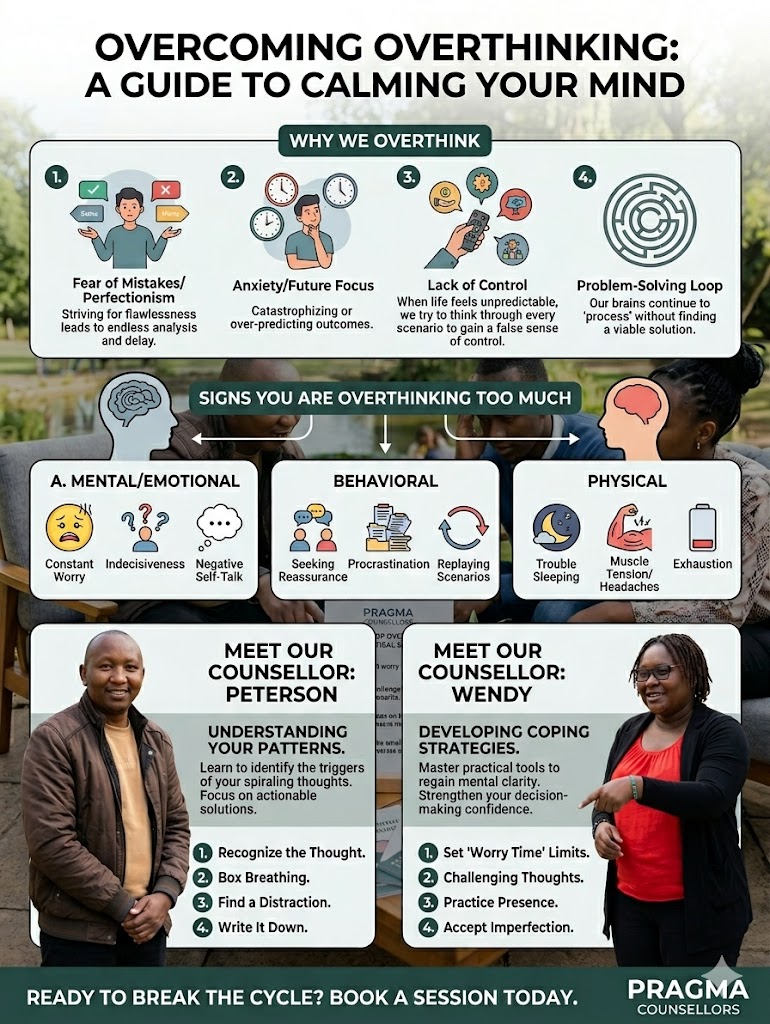
Why Do You Overthink Everything?
If you knew the “why,” you would be halfway to the “how.” People rarely overthink for no reason. Usually, it stems from a deeper need.
- Anxiety: When you feel out of control, your brain tries to predict the future to keep you safe.
- Fear of Judgment: You overthink because you worry about how others perceive your choices.
- Perfectionism: You believe that if you think about it long enough, you can find the “perfect” solution, which simply doesn’t exist.
- A Need for Control: When life feels unpredictable, overthinking feels like a shield. It feels like “doing something,” even if it’s just worrying.
Signs You Are Overthinking Too Much
Sometimes we don’t realize we’re overthinking until we are already burnt out. Look for these red flags:
The Warning Signs
- Mental: You feel foggy, indecisive, and frequently doubt your own judgment.
- Behavioral: You constantly ask friends for reassurance, or you procrastinate on tasks because you are afraid to “mess up.”
- Physical: You might experience tension headaches, a tight chest, or that dreaded “racing heart” feeling that keeps you awake at 2:00 AM.
How Overthinking Affects Your Mental Health
Overthinking isn’t just a nuisance, it’s a stressor.
- The Stress Loop: Your body treats your thoughts as real threats, flooding you with cortisol (the stress hormone).
- Stolen Productivity: You spend so much energy worrying that you have no fuel left for action.
- Sleep Deprivation: When your mind won’t quiet down, your sleep cycle breaks, making you more anxious the next day. It’s a vicious cycle.
How to Stop Overthinking (Practical Strategies)
You don’t have to overhaul your personality. Just start by changing how you handle your thoughts.
- Spot the Pattern: When you notice yourself spiraling, name it. Simply saying, “I am overthinking right now,” creates a small gap between you and the thought.
- Challenge the Thought: Ask yourself: Is this fact or feeling? If it’s a feeling, acknowledge it and let it pass.
- The “Controlled Worry” Window: Give yourself 10 minutes to worry. After that, move on to a task that requires your full focus.
- Take Action: Action is the antidote to anxiety. Even a tiny step, like writing one sentence of an email, breaks the paralysis of overthinking.
- Practice Mindfulness: You can’t worry about the future if you are fully present in the current moment. Notice the smell of your coffee, the sound of the rain, or the feeling of your feet on the ground.

How to Calm Your Mind Instantly
When the panic hits and your thoughts are racing, try these quick “reset” buttons:
- Box Breathing: Inhale for 4 seconds, hold for 4, exhale for 4, and hold for 4.
- The 5-4-3-2-1 Technique: Identify 5 things you see, 4 you can touch, 3 you hear, 2 you smell, and 1 you can taste. This pulls your brain out of your head and back into reality.
When Should You Seek Help?
If you feel like your thoughts have become a prison, where you cannot sleep, work, or enjoy time with your family, it is time to reach out for help. You don’t have to do this on your own.
How Counselling Helps
At Pragma Counsellors, we provide a space to unpack these thought patterns. Counselling isn’t just for “crisis”; it’s for learning how to live in your own head comfortably. We help you identify your specific triggers and give you the tools to rebuild your confidence in your decision-making.
Conclusion: Take Control of Your Thoughts
You are the driver of your mind, not the passenger. While it might feel like your thoughts control you, you have more power than you realize. It takes practice, and it takes time, but you can learn to replace the constant noise with clarity.
Ready to find peace? If your mind feels too loud, Pragma Counsellors is here to listen and guide you. [Book a session today] and start your journey toward a quieter, more balanced mind.

Frequently Asked Questions (FAQs)
Q1: Why do I overthink everything? Usually, it’s a learned behavior to manage anxiety, fear, or a desire for perfection.
Q2: Can overthinking be stopped? Yes. You can’t stop having thoughts, but you can definitely learn to stop overthinking them.
Q3: Is overthinking a mental illness? It is not a disorder itself, but it is a major symptom of anxiety and chronic stress.
Q4: How does counselling help? Counselling teaches you to recognize when you’re spiraling and provides strategies to “ground” yourself back into the present.
