

By a Counselling Psychologist | Pragma Counsellors, Nairobi
Why Do Teenagers Become Rude and Arrogant?! Your teenager slams the door so hard the pictures shake. You asked a simple question “How was school?” and they responded with a look so cutting you felt it in your chest. You are not imagining it. You are not failing as a parent. And you are definitely not alone.
I have sat across from hundreds of parents in my counselling room who said the same thing with the same exhausted eyes: “I don’t know who this child is anymore.” Some of them cried. One father told me he had started taking a longer route home from work just to delay walking through his own front door. That hit me hard. Because I knew exactly what was driving it , and it wasn’t him.
Here is what most parents are never told: teenage rudeness and arrogance are, in the overwhelming majority of cases, a developmental process happening inside your child’s brain. It is not personal. It is not permanent. But it does need to be understood ,and in some cases, it needs professional attention.
Let me break it all down for you. Just what I know from a 5 plus of years sitting in rooms with teenagers and their worn-out, well-meaning parents.
The Teenage Brain Is Literally Under Construction (And That Changes Everything)
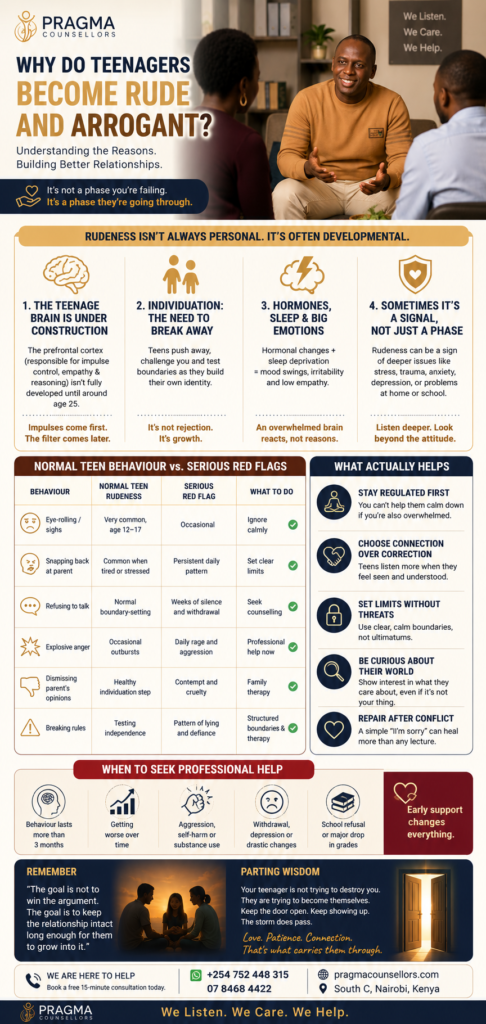
If I could wave a magic wand and have every parent understand one thing about adolescence, it would be this: the prefrontal cortex the part of the brain responsible for impulse control, empathy, reasoning, and long-term thinking is not fully developed until around age 25.
That is not a metaphor. That is neuroscience. During the teenage years, the brain is undergoing the most dramatic restructuring it has experienced since infancy. Old neural pathways are being pruned. New ones are being laid. And in the middle of all that chaos, your teenager is running almost entirely on the emotional, reactive limbic system.
What does that mean in real life? It means that when you ask your 15-year-old to put their phone down for dinner and they respond with “You are so annoying,” they are not choosing to be cruel. Their brain is genuinely not yet wired to pause, consider your feelings, and respond thoughtfully. They feel the irritation first. The impulse fires. The words come out. The filter hasn’t fully loaded yet.
I am not saying this to excuse the behaviour. I am saying it so you stop taking it as a verdict on your parenting. The rudeness is developmental, not personal most of the time. Understanding that distinction is where good parenting strategy begins.
Individuation: Why Teenagers Push You Away (And Why That Is Actually a Good Sign)
There is a psychological concept called individuation the process by which a young person separates their identity from their parents and builds a self of their own. Erik Erikson called it the stage of Identity vs. Role Confusion. And it is supposed to happen. In fact, if it doesn’t happen, you have a bigger problem.
The teenager who challenges everything you say, dismisses your opinions, and acts like being seen with you in public is equivalent to a public execution? They are individuating. They are doing the work of becoming a person separate from you. It is healthy. It is necessary. And I will admit it is incredibly painful to be on the receiving end of.
I remember one session where a 16-year-old girl told her mother right in front of me “You don’t know anything about real life.” The mother looked like she had been slapped. This was a woman who had built a career, raised three children, and overcome genuine hardship. And her daughter dismissed it with one sentence. What the daughter was really saying was: “I need to believe I can figure things out without you.” That is not arrogance. That is terrifying vulnerability dressed up as contempt.
The parents who struggle most with this phase are often the most loving the ones who were very close to their child through primary school. The closeness makes the rejection feel sharper. But the separation is not a sign that the relationship is broken. It is a sign that your child is growing.
Hormones, Sleep Deprivation, and the Emotional Power of Adolescence
Let us talk about what is happening inside the body during the teenage years, because parents often underestimate just how physically overwhelming puberty is. Oestrogen, testosterone, cortisol these hormones are surging at levels teenagers have never experienced before. They do not have the emotional vocabulary or the neurological infrastructure to process them smoothly.
Then add the sleep piece. Research from the American Academy of Sleep Medicine is clear: teenagers need 8–10 hours of sleep per night. Most get 6 or fewer. And it is not purely laziness their circadian rhythm genuinely shifts during puberty, making it biologically harder to fall asleep early. When you wake a teenager up at 6 a.m. for school, their brain is, in effect, still in the middle of the night.
Sleep deprivation and hormonal surges together create a version of your child who is emotionally raw, irritable, easily overwhelmed, and low on empathy. They are not being difficult for sport. They are genuinely dysregulated. I have found that in many families I work with, simply addressing chronic sleep deprivation leads to a measurable reduction in conflict within weeks.
I once had a 14-year-old boy whose parents brought him in describing him as “aggressive and disrespectful.” Within the first session, I discovered he was sleeping five hours a night, skipping breakfast, and managing the social stress of a new school. He was not a troubled child. He was an overwhelmed child running on empty. We fixed the sleep. His parents cried at the follow-up. “He’s back,” the mother said.
Trauma, Home Environment, and When Rudeness Is a Symptom Not a Phase

I want to be honest with you about something harder to say: sometimes the rudeness and arrogance are not just developmental. Sometimes they are a signal. A flare being fired into the air.
In my practice, I have seen teenagers whose aggressive behaviour was the only language available to them to express that something was very wrong. A father who drank too much. A parent going through depression and not recognising it. A home with unspoken tension between the adults. A child who had experienced something at school they did not know how to name.
The teenagers who are most contemptuous and most arrogant are often, underneath it all, the most afraid. The armour is thick because what is underneath feels unbearable. When a teenager’s rudeness is persistent, escalating, and accompanied by other changes withdrawing from friends, dropping grades, disrupted sleep or eating, self-harm, or substance use it is not a phase. It is a call for help.
If that description fits your child, please do not try to discipline your way through it. Please get professional support. Not because something is permanently wrong with your child, but because they are carrying something too heavy to carry alone.
Normal Teen Behaviour vs. Serious Red Flags
| Behaviour | Normal Teen Rudeness | Serious Red Flag | What To Do |
|---|---|---|---|
| Eye-rolling / sighs | Very common, age 12–17 | Occasional | Ignore calmly |
| Snapping back at parent | Common when tired or stressed | Persistent daily pattern | Set clear limits |
| Refusing to talk | Normal boundary-setting | Weeks of silence and withdrawal | Seek counselling |
| Explosive anger | Occasional outbursts | Daily rage and aggression | Professional help now |
| Dismissing parent’s opinions | Healthy individuation step | Contempt and cruelty | Family therapy |
| Breaking rules | Testing independence | Pattern of lying and defiance | Structured boundaries and therapy |
Real Talk: What Does Not Work (And Why Parents Keep Trying It Anyway)
I am going to be opinionated here because I have watched the same mistakes play out in my consulting room for over a decade.
Matching their energy is a total waste of time. When a parent screams back at a screaming teenager, both parties flood with cortisol and the prefrontal cortex goes offline for everyone in the room. I have never seen a parent win an argument they had at full volume. Not once.
Grounding them for weeks does not teach what you think it teaches. Extended punishments breed resentment, give teenagers enormous time to catastrophise, and remove the positive interactions that are your most powerful parenting tool. Short, clear, immediate consequences work. Month-long punishments mostly damage the relationship.
“We never spoke to our parents like that” is the least useful sentence in parenting. Your teenager is dealing with social media, algorithmic anxiety, an uncertain economic future, and a mental health crisis affecting one in five young people. Comparing their experience to yours closes the conversation before it opens.
Waiting for them to “grow out of it” without any intervention is a gamble. Most of the time, they will grow through the developmental piece. But if there is an underlying mental health issue or unresolved trauma driving the behaviour, waiting costs precious time. Early intervention gets dramatically better outcomes than late intervention.
What Actually Helps: Practical Strategies That Work
- Stay regulated yourself first. You cannot co-regulate a dysregulated teenager if you are also dysregulated. Leave the room if you need to. Come back when you are calm. This is not weakness. It is skill.
- Choose connection over correction. A teenager who feels genuinely seen by you is far more likely to listen to you. Before the lecture, try the check-in.
- Set limits without ultimatums. “When you speak to me that way, I am going to step away” is a boundary. “If you speak to me like that one more time you will lose your phone forever” is a threat and teenagers test threats.
- Find something they care about and get curious about it. Football. A band. A YouTube creator. It does not have to interest you. It has to interest them. Genuine curiosity is a relationship bridge.
- Repair after conflict, every time. A simple “I overreacted earlier, I am sorry” from a parent is more powerful than any lecture. It models the behaviour you want. It keeps the relationship warm.
Bonus tip: Write it down. Some teenagers communicate far more freely in writing than face-to-face. A note slipped under the door or a WhatsApp message can open doors that a conversation would slam shut.

Frequently Asked Questions
Is it normal for teenagers to be rude to their parents? Yes, within limits. Mild rudeness eye-rolling, short answers, dismissiveness is a normal part of adolescent brain development. It becomes a problem when it is persistent, cruel, or aggressive.
At what age do teenagers become most difficult? Research points to ages 14–16 as the peak of conflict, when prefrontal cortex development is lagging furthest behind emotional intensity. By 17–18, most teens start to regulate better.
What causes sudden attitude changes in teenagers? Hormonal shifts, sleep deprivation, social stress at school, peer pressure, and big life transitions like changing schools or parents divorcing can all trigger sudden behavioural changes.
Should I punish my teenager for being rude? Punishment alone rarely works long-term. Natural consequences, clear boundaries, and open conversation are far more effective. If the rudeness is severe, professional support helps more than punishment.
How do I get my teenager to respect me again? Start by modelling the respect you want. Lower the temperature in arguments. Find one thing each week to genuinely praise. Repair the relationship before re-establishing authority.
When should I seek help from a counsellor? If your teenager’s behaviour has lasted more than three months, is getting worse, or includes aggression, self-harm, substance use, or school refusal seek professional support immediately.
You Do Not Have to Navigate This Alone
At Pragma Counsellors in Nairobi, we work with teenagers, parents, and families navigating exactly these challenges. Whether your child needs individual support, or you need a space to process this as a parent we are here.
Book a free 15-minute consultation today. 📞 Call/WhatsApp: +254 752 448 315 🌐 Website: pragmacounsellors.com 📍 Location: South C, Nairobi, Kenya
Parting Wisdom
Here is the truest thing I know after more than 5years of this work: the teenagers who seemed most impossible to reach were almost always the ones who needed the most love delivered in the most unexpected ways.
Your teenager is not trying to destroy you. They are trying to become themselves. That process is loud, clumsy, and sometimes brutal. But on the other side of it is a person who, if you can hold the relationship together through this season, will very likely become one of your greatest sources of pride and joy.
“The goal is not to win the argument. The goal is to keep the relationship intact long enough for them to grow into it.”
That is what I tell every parent who walks into my room with those tired eyes. Keep the door open. Keep showing up. The storm does pass.
Over to You
Which part of this resonated with you the most? Are you currently navigating a specific behaviour with your teenager that you would like guidance on? Drop your question or experience in the comments below , I read every single one and respond where I can. And if this article helped you, share it with another parent who might need it right now. You never know who is sitting in their car in the driveway, dreading walking inside.
Pragma Counsellors | pragmacounsellors.com | +254 752 448 315 |0784 684 422 South C, Nairobi
